Tech Portfolio Field Guide
A free field guide to technology portfolio management. Twenty-five principles, told through stories, for the people who run the machine.

A free field guide for the people who run technology portfolios. Edition 2: seventy pages, twenty-five principles, one frame.
Picture the Monday portfolio review. Forty-odd items on the slide, eleven of them marked priority one, two that have been “nearly done” since spring. The meeting runs over. Three new ideas get added. Nothing gets stopped.
The Tech Portfolio Field Guide is for the people in that room: CTOs and CIOs, heads of engineering and delivery, portfolio and PMO leads, product leaders, and the architects who end up holding the consequences. It’s a free, practical guide to technology portfolio management, built around two honest questions. Is this idea becoming valuable? And is it worth being part of?
Inside are twenty-five principles, each told through a short story and followed by something you can use on Monday: red flags to look out for, questions to ask, steps to improve and something to try in the field.
Free field guide · Edition 02
Take something useful into Monday’s portfolio review.
Twenty-five principles for technology portfolio management, each told through a story, with red flags, questions, five steps and something to try in the field.
- Free with Meeting Notes
- 70 pages
- 25 principles
- 5 layers
- A4 landscape PDF
Financial Value lives outside the building
Financial value (Revenue) tends to come from one place: a customer, outside the organisation, paying for something they think is worth paying for. Everything inside the building is investment. The salaries, the cloud bill, the roadmap and the six meetings about the roadmap. On the books it’s cost. In the idea, it’s potential.
Cost reduction, enablement and learning matter too. They're investment in future value: upstream of the money, not beneath it. But until they turn up in something a customer values, someone is still paying for them.
The most common mistake I see in technology portfolios is assuming all work earns money directly, then wondering why costs keep climbing. So the guide starts there, with one frame that everything else sits on.
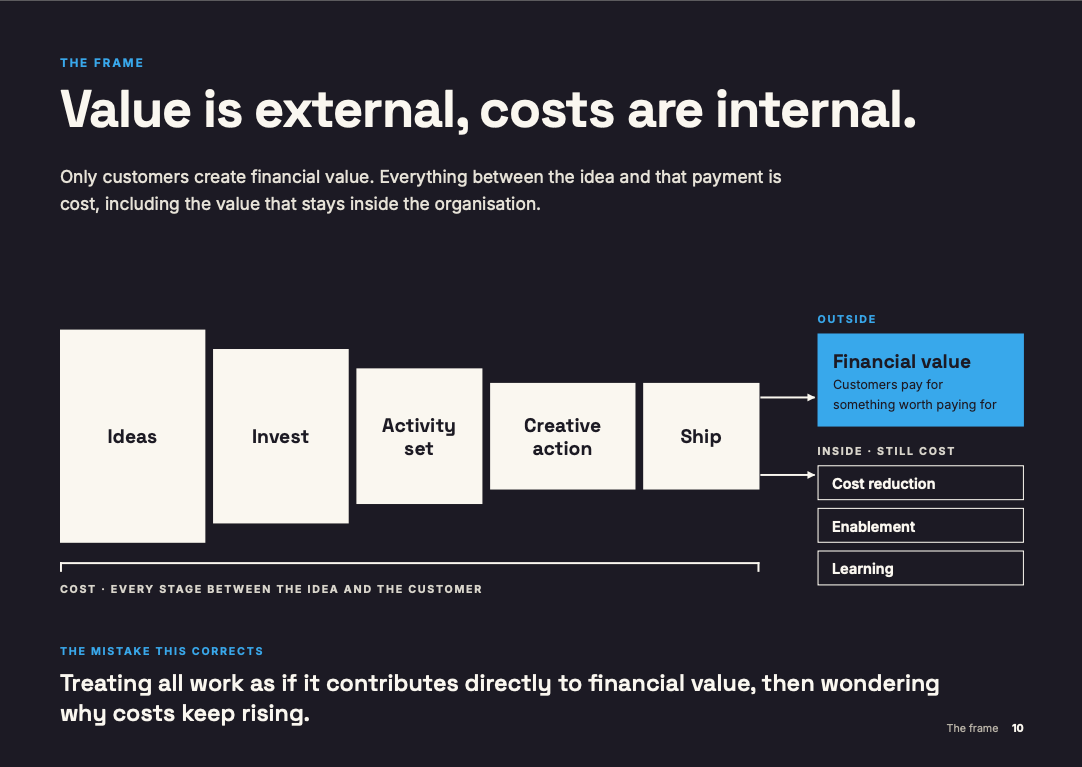
The frame the guide sits on
Value is external. Costs are internal.
Every stage between the idea and the customer is investment
Outside
Financial value
A customer pays for something worth paying for.
Inside · still cost
Cost reduction, enablement, learning
They matter, and they sit on the cost side until customers feel them.
Shrink the distance between investment and value
Cost gathers in the time between committing to an idea and finding out whether anyone wants it. Fewer things in flight, smaller pieces, earlier feedback and clearer decisions all shrink that distance, and the shorter it is, the less you pay to learn the truth about an idea.
But a portfolio isn’t only a machine. The complicated parts (architecture, pipelines, funding models, governance) can be studied and engineered. The complex parts are made of people, and people can’t be optimised, only cultivated. That’s why creativity, climate and communication sit at the heart of this guide rather than in a soft chapter at the back.
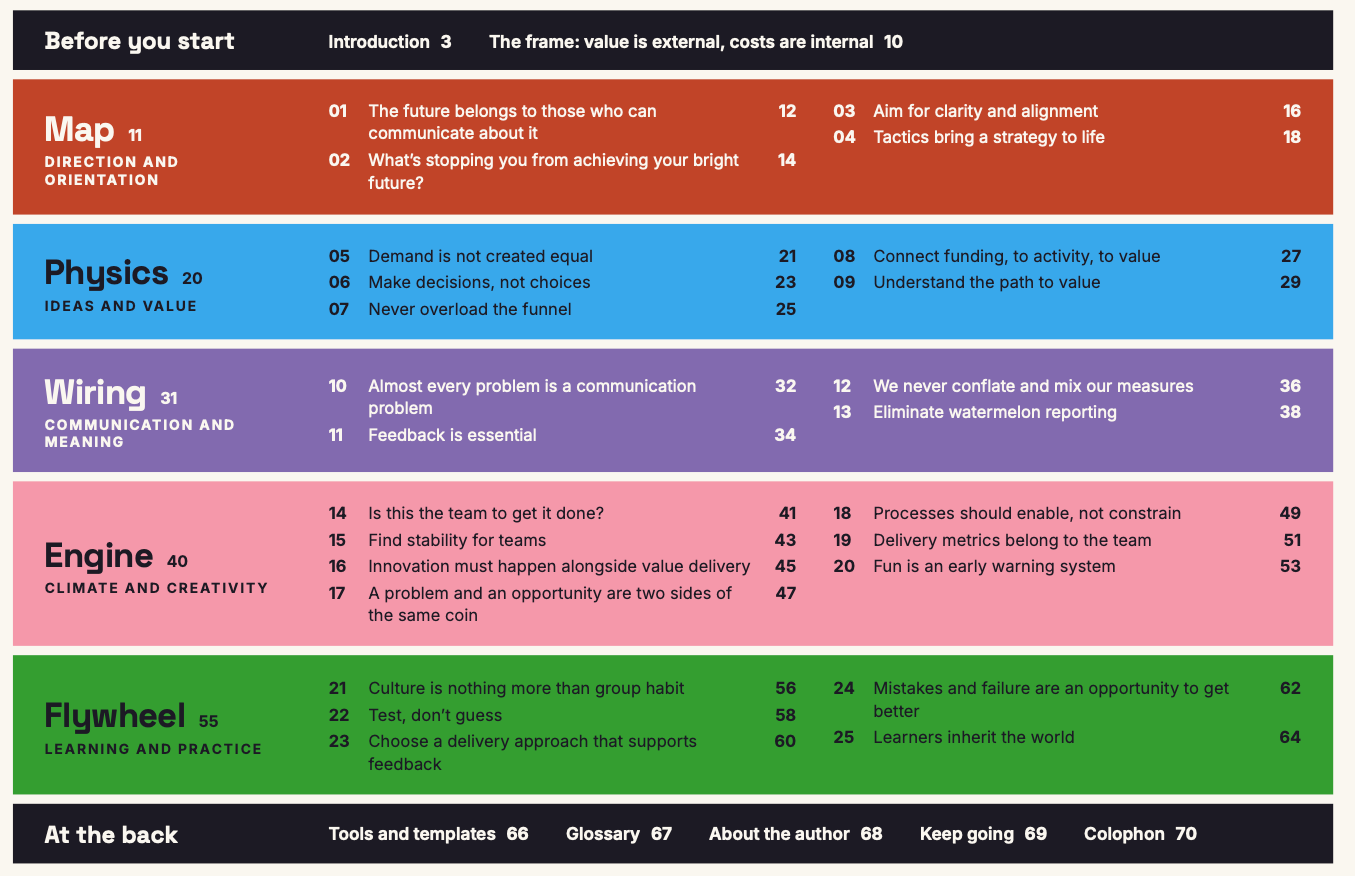
What’s inside: five layers, twenty-five principles
The principles are grouped into the five layers of Idea to Value, from direction and orientation through to learning and habits. Read it straight through once, then dip in wherever your portfolio hurts.
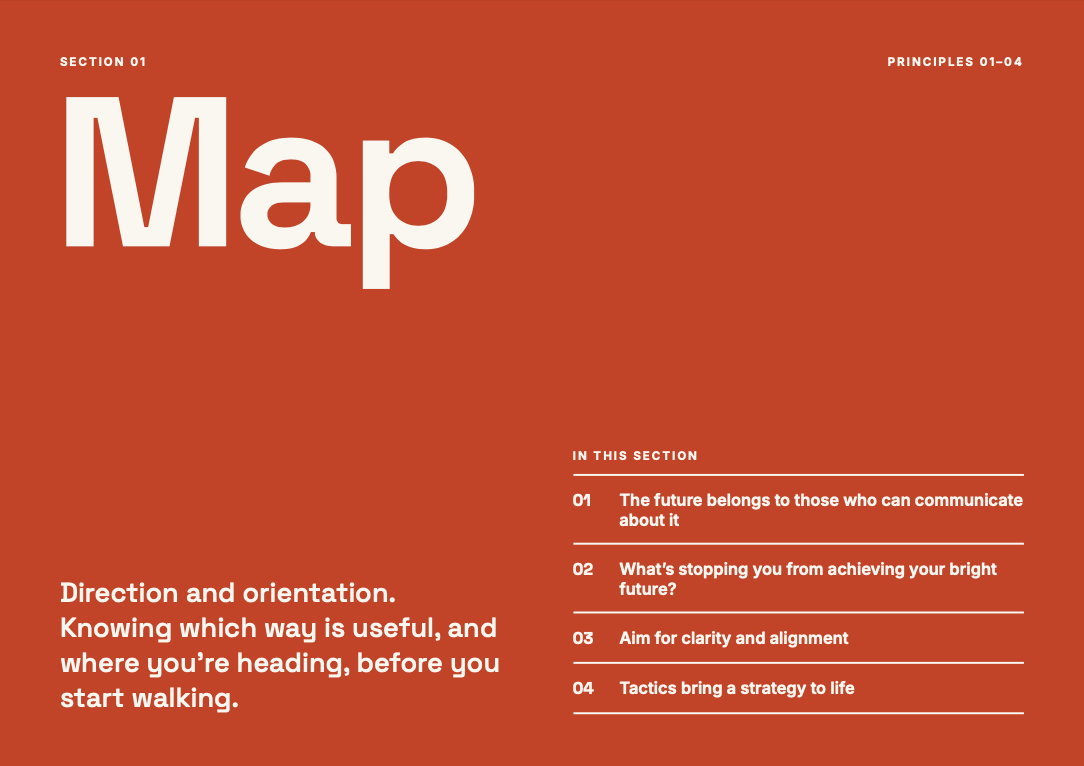
Map
Direction and orientation
- 01 The future belongs to those who can communicate about it
- 02 What’s stopping you from achieving your bright future?
- 03 Aim for clarity and alignment
- 04 Tactics bring a strategy to life
Physics
Ideas and value
- 05 Demand is not created equal
- 06 Make decisions, not choices
- 07 Never overload the funnel
- 08 Connect funding, to activity, to value
- 09 Understand the path to value
Wiring
Communication and meaning
- 10 Almost every problem is a communication problem
- 11 Feedback is essential
- 12 We never conflate and mix our measures
- 13 Eliminate watermelon reporting
Engine
Climate and creativity
- 14 Is this the team to get it done?
- 15 Find stability for teams
- 16 Innovation must happen alongside value delivery
- 17 A problem and an opportunity are two sides of the same coin
- 18 Processes should enable, not constrain
- 19 Delivery metrics belong to the team
- 20 Fun is an early warning system
Flywheel
Learning and practice
- 21 Culture is nothing more than group habit
- 22 Test, don’t guess
- 23 Choose a delivery approach that supports feedback
- 24 Mistakes and failure are an opportunity to get better
- 25 Learners inherit the world
Every principle, told through a story
Portfolio management guides tend to read like playbooks. This one doesn’t. Each principle opens with a story: a motorway that jams when it’s full, a fishing line you can feel, a sourdough starter that only works because it’s old, a darkroom test strip. The second page then gives you something to do.
Page one
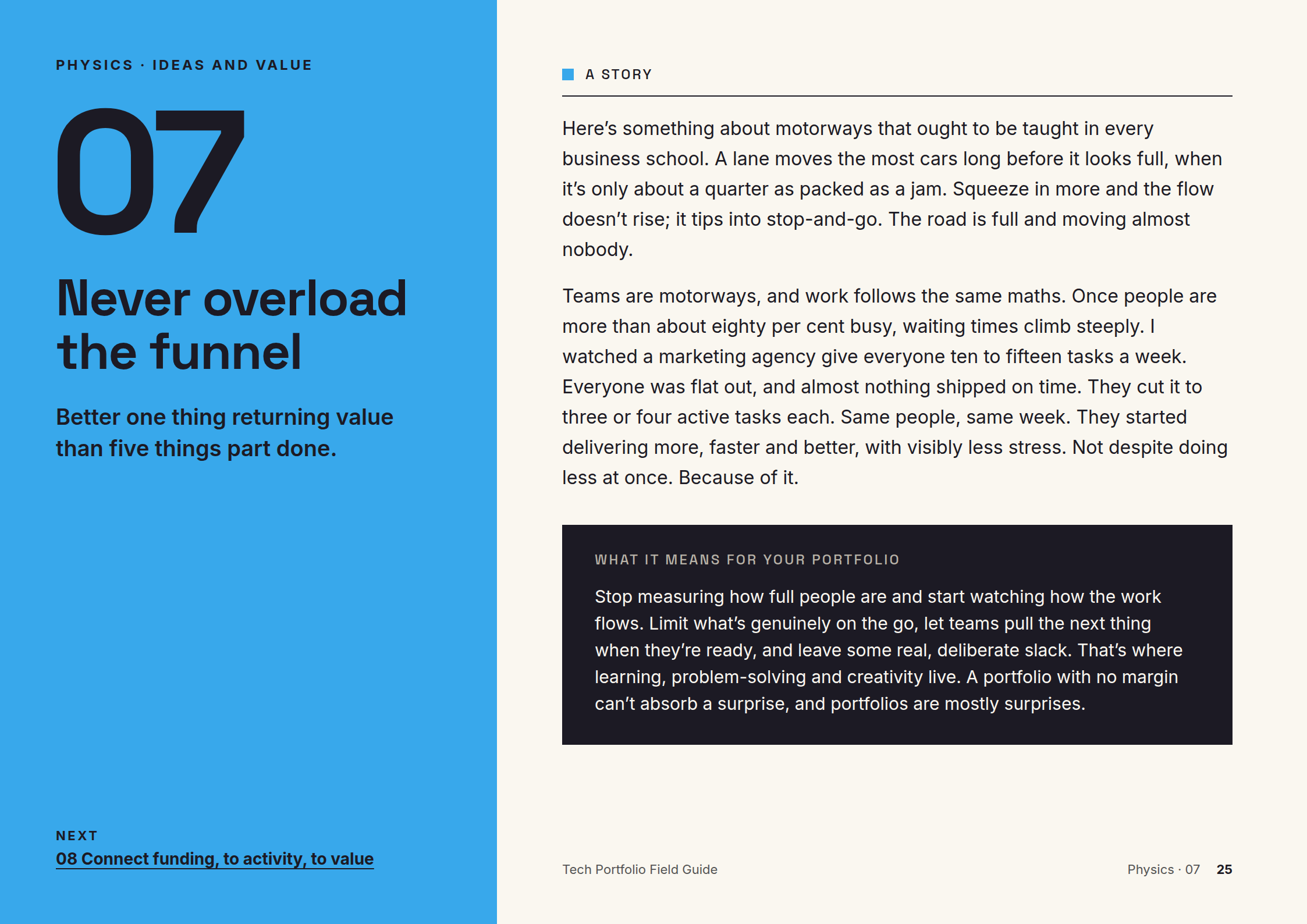
A story
“A lane moves the most cars long before it looks full, when it’s only about a quarter as packed as a jam. Squeeze in more and it tips into stop-and-go. Teams are motorways.”
From 07, Never overload the funnel. Each story ends with what it means for your portfolio.
Page two
Something to do
- Red flags to look out for
- Questions to ask in your next review
- Five steps to improve
- When it works, and when it doesn’t
- In the field: something to try this week

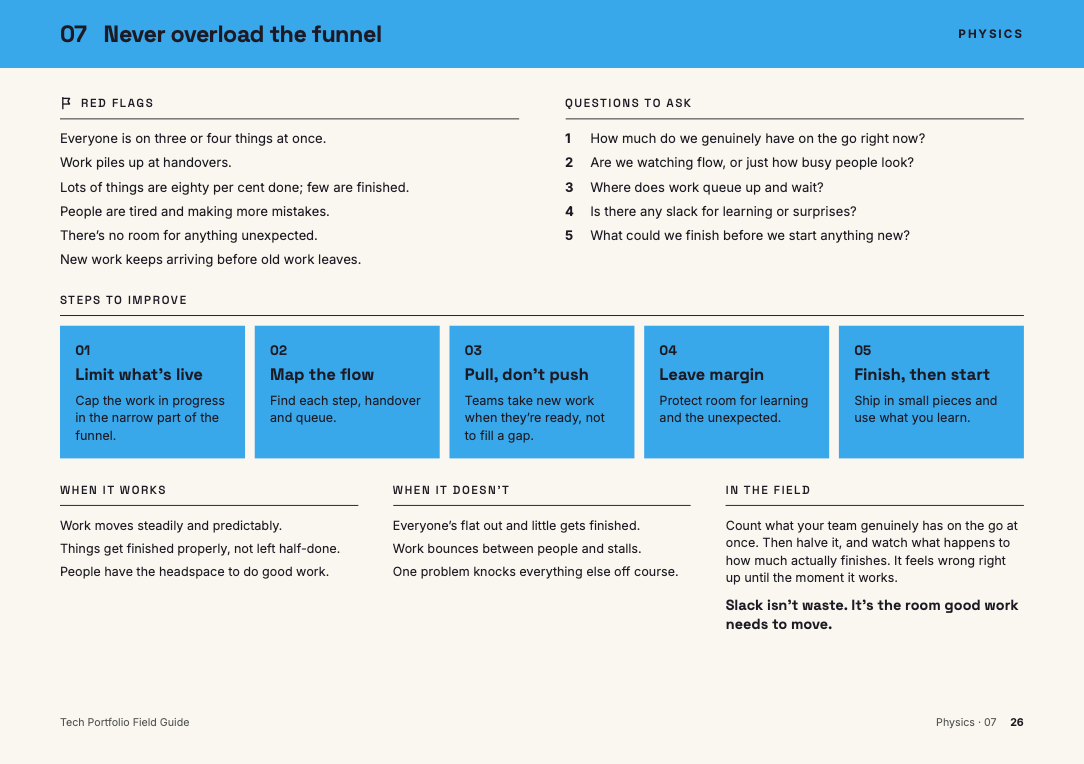
Images from the Tech Portfolio Field Guide
Who it’s for
It’s written for anyone responsible for turning a stream of technology ideas into something valuable: CTOs and CIOs, heads of engineering, delivery and product, portfolio and PMO leads, and the team leads and architects who live with the consequences. It works whether your portfolio is five teams or five hundred, and whatever delivery method you use. The principles don’t care about the method. They care whether ideas reach value.
A way of seeing, not a framework to install
Idea to Value is a way of seeing your work, not a method to roll out. Borrowed seeing, running someone else’s framework line by line, rarely survives contact with a real portfolio. Use the guide to look at yours more clearly, and then trust what you see. If you’d like the thinking behind it, start with What Lean Portfolio is and what the word portfolio really means.
Questions people ask
Is it really free?
Yes. Join Meeting Notes, my free Sunday letter, and it's yours, along with everything in the members' library. Print it and share it with your team. Please just don't sell it, or change it and pass it on as your own.
Is this a portfolio management framework?
No. It’s a set of principles and a way of seeing. It sits alongside whatever you already use, from Lean Portfolio Management to a spreadsheet and a good conversation.
How is it different from The Life of an Idea?
The Life of an Idea is the same set of principles written for everyone, as short essays. The Tech Portfolio Field Guide is the practitioner’s edition for technology portfolios, with red flags, questions, steps and exercises for every principle.
Do I need to read it in order?
No. Every principle stands on its own two pages. Read it straight through once if you like, then dip in wherever your portfolio hurts.
About Rob Lambert
I'm Rob. I've spent twenty years inside organisations – as VP of Engineering, VP of HR, Head of Business Agility, and independently – studying how ideas become value, and where they don't. Long enough on both sides of the wall to know that the results a business needs and the growth its people deserve aren't separate subjects.
These days I write, speak, advise and teach through Cultivated.
More about the wider practice →
Help with the real portfolio
Free field guide · Edition 02
Take something useful into Monday’s portfolio review.
Twenty-five principles for technology portfolio management, each told through a story, with red flags, questions, five steps and something to try in the field.
- Free with Meeting Notes
- 70 pages
- 25 principles
- 5 layers
- A4 landscape PDF