The Life of an Idea
Twenty years of experience on why good work gets stuck, written down in 26 short chapters. For anyone who wants their work to go better, and to be the person who helps it.
Some weeks, work feels harder than it should. The project that's been eighty per cent done since spring. The meeting that ends by booking two more. The good idea that goes nowhere because it came from the wrong floor. Everyone working hard, and somehow the work isn't moving.
None of that is your imagination, and almost none of it is anyone's fault.
It's what happens to ideas on their way to becoming something valuable, when nobody can quite see the whole path they're travelling. Once you can see it, you usually know what to do.
No. 08 in the seeing series · the place to start
A small book about making work better. Yours first.
Twenty-six short chapters on why good work gets stuck and how to see what’s in the way, each with one thing to try at work this week.
- £5.99, one purchase
- 83 pages
- 26 short chapters
- PDF, instant download
What changes when you can see it
It gives you a way of looking at work that you'll use for the rest of your career.
In practice, that means:
01
See why the work is stuck
Spot the waiting, the overload and the decision nobody quite made, before they turn up as a missed date.
02
Fix the cause, not the symptom
Ask the question that moves a meeting from who’s to blame to what’s in the way.
03
Get more good work finished
Fewer things on the go, clearer priorities, shorter feedback loops. Less effort, more of it landing.
04
Grow your career
Become the person people bring the tangled problems to. In most organisations, that’s who gets asked to lead next.
Twenty years of experience, in a book you can read on a train
For twenty years I've been paid to walk into organisations and work out why their good ideas weren't arriving. I've done it as a VP of Engineering, twice, as VP of HR, as Head of Business Agility, and as an independent advisor to teams of one, six and sixteen thousand people. The same patterns turned up everywhere, whether the idea was a software platform, a new service or a book written at a kitchen table.
The Life of an Idea is what I'd tell you if you hired me for a week. Every principle is something I've watched hold true in real organisations, and every one is told through a story you'll recognise: the motorway at eighty per cent, the smoke alarm with its battery taken out, the company that built four apps for the same customer. It's distilled, not diluted. Made understandable, not simplified.
There's no framework to install and no jargon to learn. It's a way of looking, so it works wherever you sit. And every chapter ends with In the field: one small thing to try at work this week.
From the stories in the book
40 days → 3
A funding approval, stripped back to what it was for. Same governance, a fraction of the drag.
19 · Processes should serve the work
15 tasks → 4
Per person, per week, at a marketing agency. Same people, more delivered, faster, with less stress.
08 · Never overload the funnel
6 months → 6 weeks
An unwinnable framework debate, settled by one small pilot. It saved millions.
23 · Move, don’t guess
40% fewer delays
On a government programme, once it was made safe to report red.
14 · Tell the truth, even when it’s red
And from my own work: an engineering team grown from 6 to more than 200 - from barely making payroll to an exit, releasing weekly instead of every 14 months; a regulated payments turnaround with 53% more delivery capability at 23% lower cost; and the Idea to Value Workshop, run more than 300 times; a delivery model change for 16,000 people.
Get the book for £5.99 →Inside: twenty-six ways of seeing
One foundation and twenty-five principles, in five layers: where you're heading, how work moves, how understanding travels, the conditions people work in, and the habits that compound.
Read it straight through once, then open it at whatever you're wrestling with this week.
Foundation
Where everything starts
- 01 The only real money
The Map
Direction
- 02 Paint the picture
- 03 You are here
- 04 Clarity, then alignment, then momentum
- 05 Strategy comes alive in the doing
The Physics
How work moves
- 06 Not all demand is equal
- 07 Decisions, not choices
- 08 Never overload the funnel
- 09 Keep the line you can feel
- 10 Shipping isn’t the same as landing
The Wiring
Communication
- 11 Almost every problem is a communication problem
- 12 Feedback is the return channel
- 13 Keep your measures unmixed
- 14 Tell the truth, even when it’s red
The Engine
People and climate
- 15 People are the engine
- 16 Keep the team together
- 17 Make creativity a habit, not an event
- 18 Every opportunity arrives holding a problem
- 19 Processes should serve the work
- 20 Your measures belong to the team
- 21 When the room goes quiet
The Flywheel
Habits that compound
- 22 Culture is group habit
- 23 Move, don’t guess
- 24 Deliver so the feedback stays alive
- 25 Mistakes are data, not drama
- 26 Made, not inherited
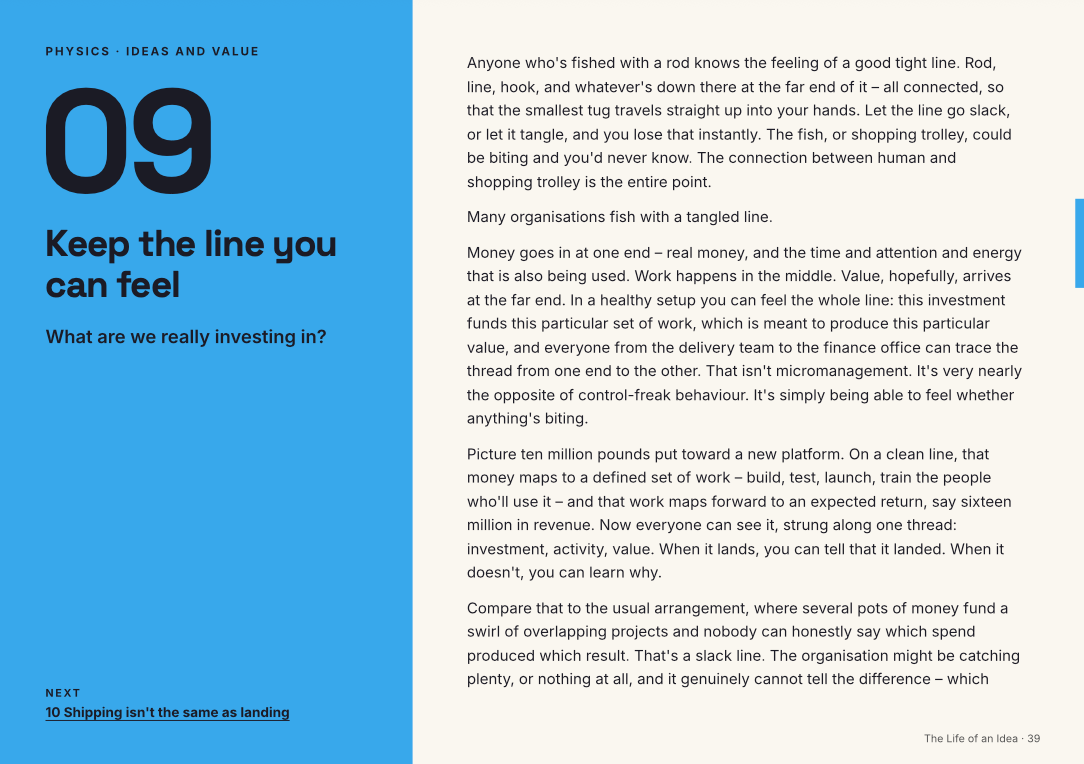
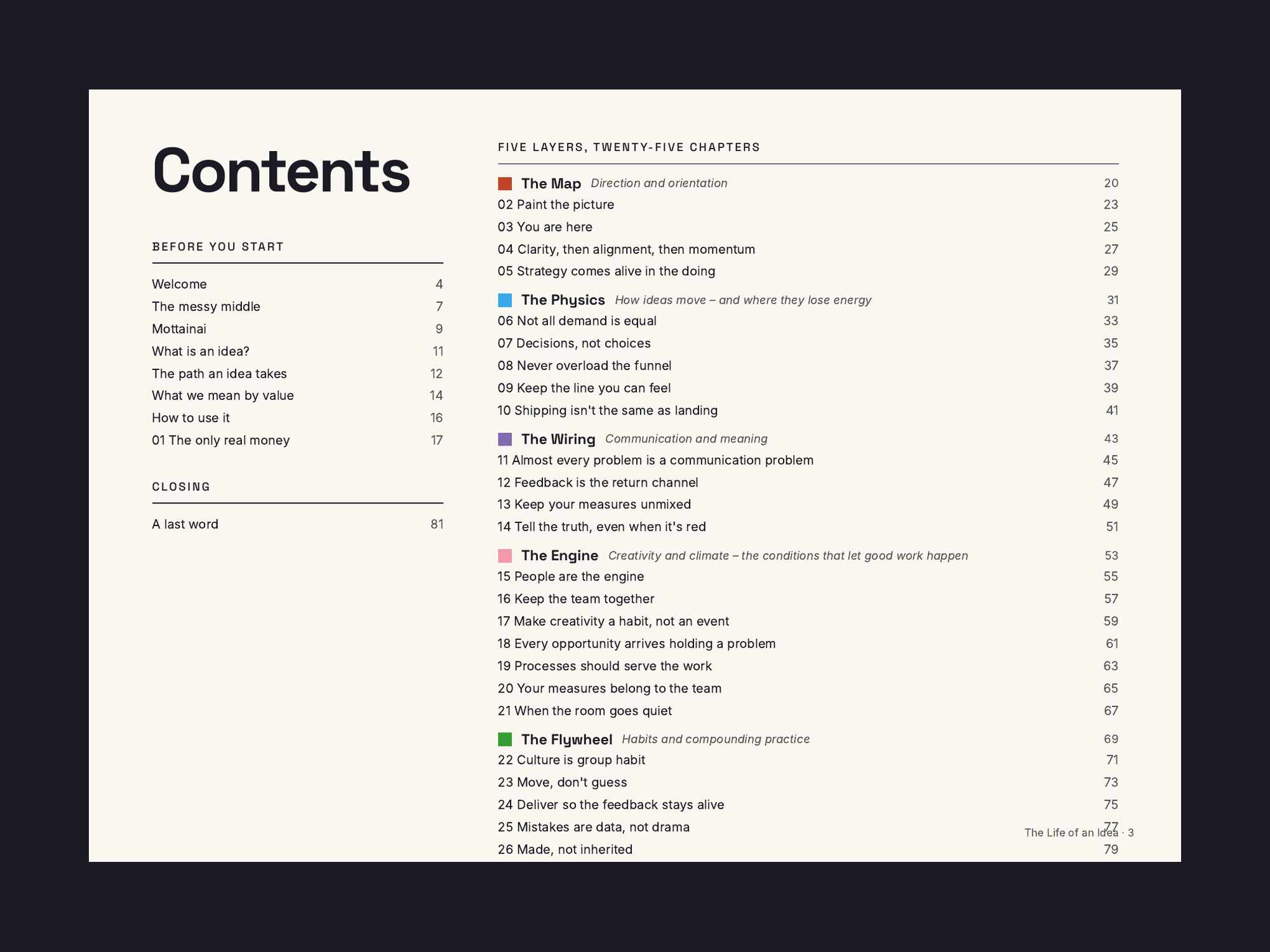
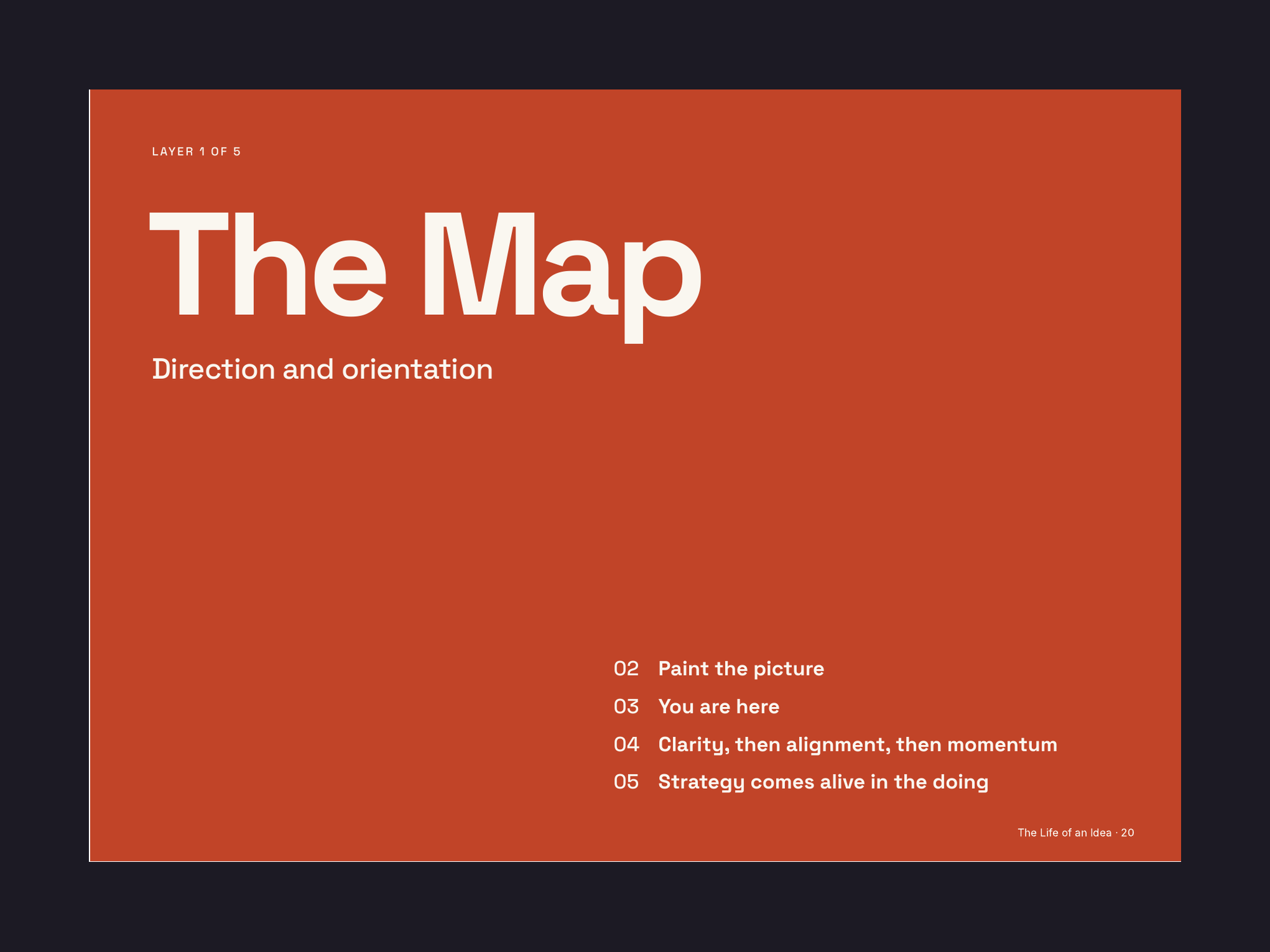
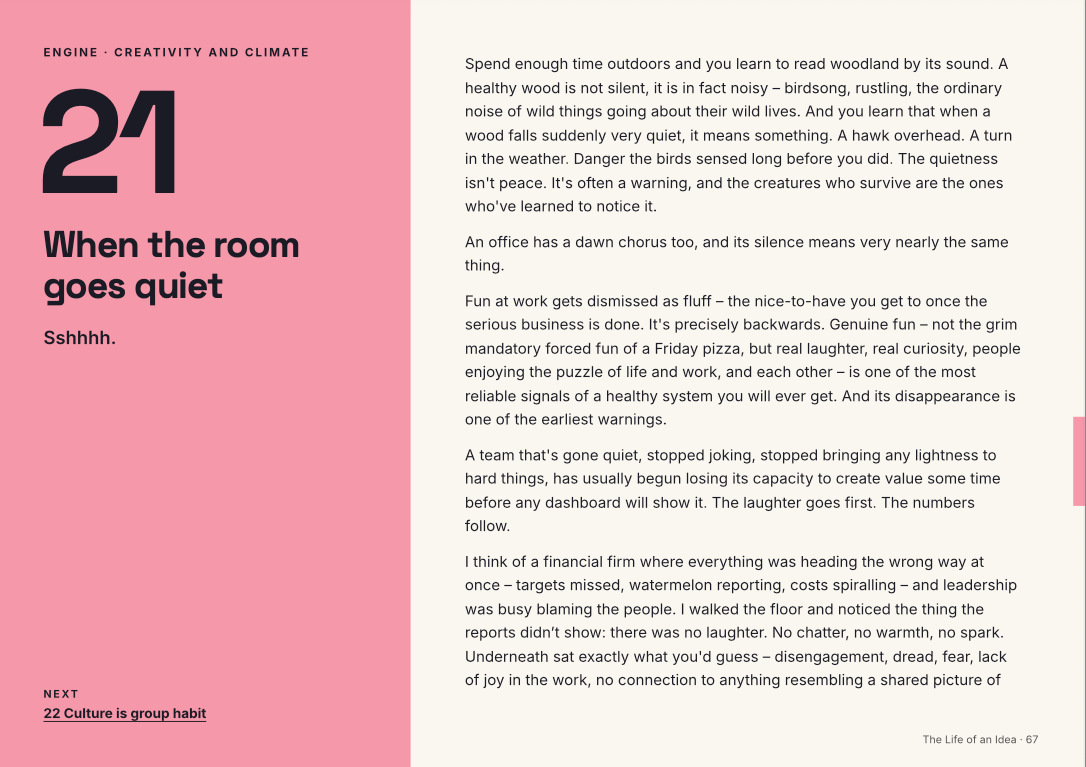
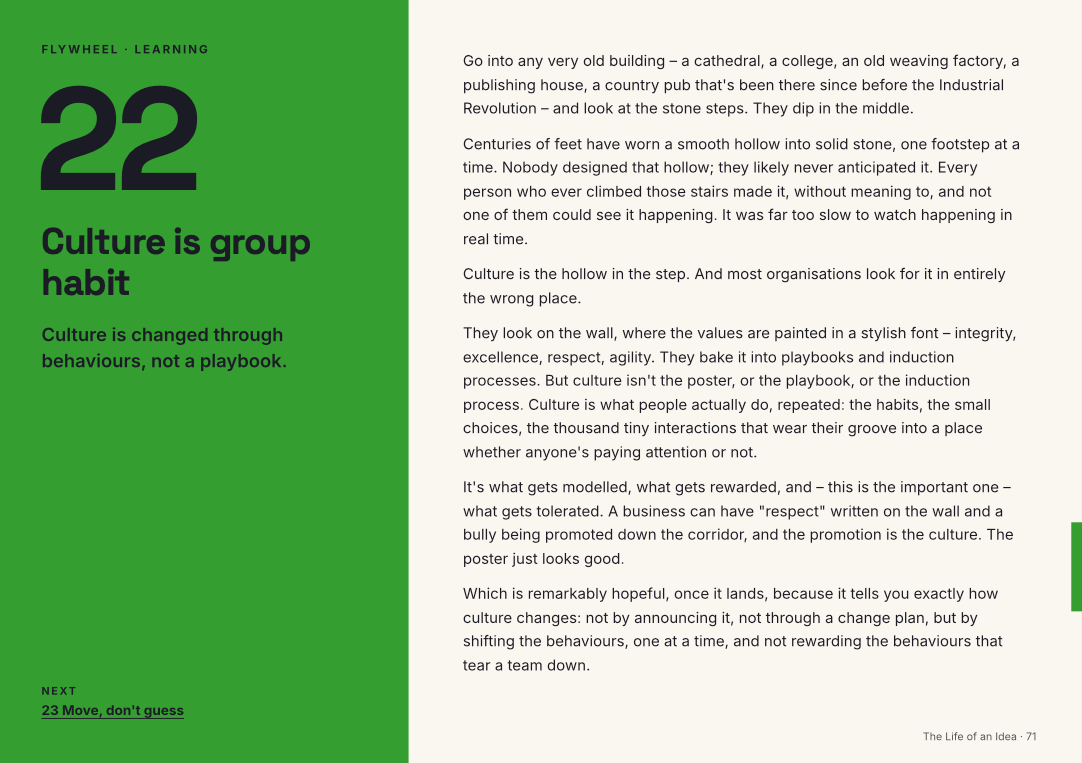
Images from inside the Life of an Idea Field Guide
A taste
The Physics
08
Never overload the funnel
A motorway doesn’t carry the optimal amount of traffic when it’s full. It carries the optimal amount at around seventy or eighty per cent of capacity. Push past that, cram in more cars because there’s technically still room, and flow collapses into a jam. The road is now full and moving almost nobody.
Teams are motorways. That’s very nearly this whole chapter.
In the field. Count what your team genuinely has on the go at once. Then halve it, and watch what happens to how much actually finishes. It feels wrong right up until the moment it works.
The real investment in a company is not just money. It's time, energy and attention of people – the truest currencies any of us has, and the ones no budget will ever top up or reclaim. – from the book
Who it's for
Anyone who cares about their work and wants it to go better.
That includes the specialist who can see the problem but can't yet name it, team leads and managers, product and delivery people, HR and operations, and founders and the people who run small studios. You don't need a title to use it. Most of the principles work from wherever you sit, and the ones that need a leader tell you what to ask for.
It isn't a book about cutting costs or squeezing people to do more with less. It will probably lower your costs, in the way that being less stressed lowers your blood pressure. It's about paying attention, so that more of the good work arrives and getting it there feels worth it.
Questions people ask
I'm not a manager. Is it for me?
Yes. Most chapters ask you to notice one thing and try one small thing, and that works at any level. Being the person who can see why work is stuck, and say so kindly, is how a lot of careers grow.
How long does it take to read?
It has 26 short chapters over 83 pages. Most people read it in an evening or two, then keep it to dip into when something's stuck. It's designed as a field guide – to be carried with you.
How is it different from the Idea to Value Handbook?
The book shows how ideas become value at work and what gets in the way. The Handbook, free with Studio, turns each principle into red flags, prompts and steps for working on a stuck idea – more a full practitioner's guide. Start with this book.
Can I buy copies for my team?
Yes. Email info@cultivatednotes.com and I'll sort out a team price. Or bring the whole team through it in a day: that's the Idea to Value Workshop.
Learn to see where the work is getting stuck.
Twenty-six short chapters and one way of looking you’ll use for the rest of your career. If one chapter gets one stuck piece of work moving, it has paid for itself.
PDF · 83 pages · A4 landscape · instant download
No. 08 in the seeing series · Designed and published in Great Britain · Set in Space Grotesk and Inter
About the author
I'm Rob Lambert. I've led software engineering teams twice, then led HR in the same business, which taught me that results and people are the same work seen from different sides. I've run the Idea to Value Workshop more than 300 times. Before all of that I was a journalist. These days I write and publish Cultivated from Winchester.
Go further