Make something of it.
There's more potential in almost everything than we give it credit for. Make something of it.
The belief behind Cultivated, and the thinking behind Idea to Value.
There's more potential in almost everything than we often give it credit for.
More in people. More in ideas. More in organisations. More in the ordinary working day. More in the things we already have. More in ourselves.
Most of it doesn't go anywhere. Nobody decides that. It just sits there: the idea in the back of a notebook, the skill nobody's asked about in years, the person in the meeting who'd have had the answer if anyone had thought to ask, the Tuesday afternoon that slipped by without anyone noticing.
I've spent twenty-odd years noticing it. And I've come to believe the most useful thing any of us can do with it is the obvious thing.
Make something of it.
A dare, pointed somewhere useful
Most of us first heard the phrase as a dare. Somewhere in the school playground, from someone slightly bigger than us. You want to make something of it?
We've kept the dare. We've just pointed it somewhere more useful.
Make something of an idea. The one you keep mentioning and keep not starting.
Make something of an opportunity. Including the small ones that don't look like much on a Monday morning but could become something much grander.
Make something of your circumstances. Even the ones you didn't choose.
Make something of your working life. Most of us have to work. It may as well be worth turning up for.
Make something of the people around you. Notice what they're good at, and give it somewhere to go. Build others up.
Make something of the time you've got. It's the only thing on this list you can't make more of.
It isn't a promise that everything works out. Some ideas won't turn into anything meaningful, and some opportunities turn out to be dead ends. It's a way of looking at what's in front of you and asking, with a slightly raised eyebrow: well, what are you going to make of it?
Mottainai
The Japanese have a word for the feeling underneath all of this: mottainai.
It's often translated as "what a waste", which misses the best of it. It's closer to reverence: a respect for the worth in things, and a reluctance to see that worth go unused. The last of the rice. A coat that could be mended. A good idea that didn't get its chance. A person operating far below what they're capable of.
That's the feeling.
Not frustration. Something closer to affection, and a nagging sense that the thing in front of you deserves more than it's getting.
So we start with what's already there, not with what's missing. Most of what an idea needs is closer than we think.
A day meant for code
Some years ago I worked at a start-up that ran a hackathon: a day set aside for building software. A group of colleagues who weren't engineers looked at it and decided to make a book instead. Write it, edit it and publish it before the clock ran out. I was the editor.
By the end of the day there was a real, published book, made by people whose job descriptions said nothing at all about writing or publishing.
Nobody gave them permission to be writers. They looked at what they'd been handed (a day, each other and a slightly odd idea) and made something of it.
It's still one of the best days of my working life, because it answered the two questions I ask of any piece of work.
Did the idea become the value it could?
Was it worth being part of?
Yes. And very much yes.
From belief to value
Belief gets you started. It doesn't get the book published by the end of the day.
Between an idea and the thing in the world there's a lot of ordinary, difficult, wonderful work. Every idea I've seen become something worthwhile has gone through three stages.
See it. Notice what's really there, and imagine what it could become.
Share it. Give it meaning, and bring people with you.
Make it happen. Get it through the messy middle and into the world, as good as it can be.
Creativity and communication sit underneath all three. One helps ideas become something. The other helps them travel.
Idea to Value
Over the years I've built a way of looking at that journey. I call it Idea to Value.
It isn't a methodology. There's no certification, and I'm not going to sell you a laminated version with a free tote bag and a baseball cap.
It's the opposite of borrowed seeing: instead of running your work through somebody else's framework or method or lens, it asks you to look for yourself at what's happening to your idea on its way into the world, in work or in your own life.
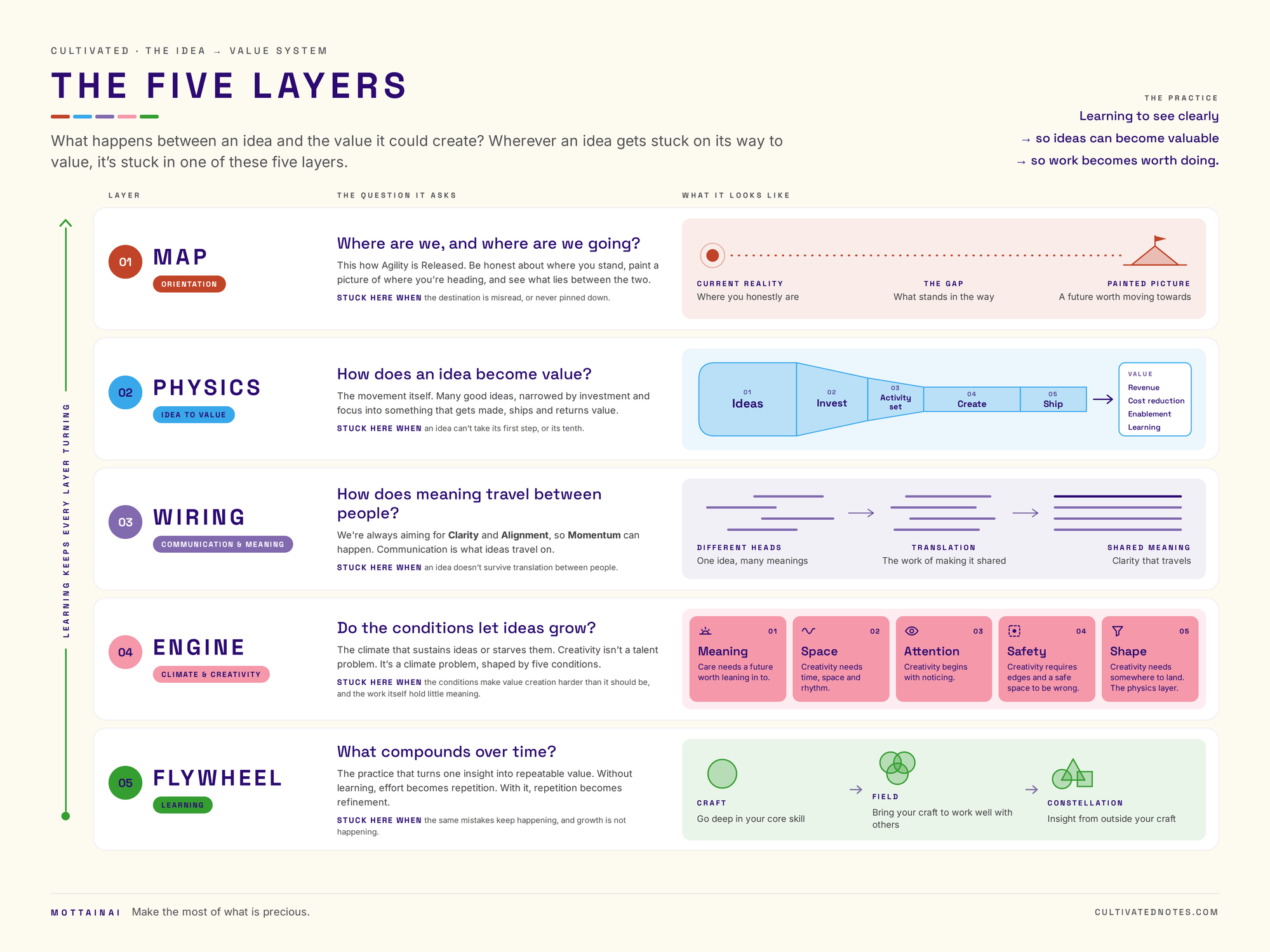
There are five places it focusses on.
The Map. Orientation. Where are we going and what are we trying to achieve?
The Physics. How is the idea actually moving, and what's getting lost on the way?
The Wiring. Is it surviving the journey between people?
The Engine. Do the conditions let people bring everything they've got?
The Flywheel. What are we learning, so the next thing is better?
The scale changes, from one person at the kitchen table to a company of thousands. The questions stay surprisingly similar.
The Life of an Idea is the short version. The Practitioner's Handbook is the working one. Idea to Sustainable Work is the one for people operating on their own ideas.
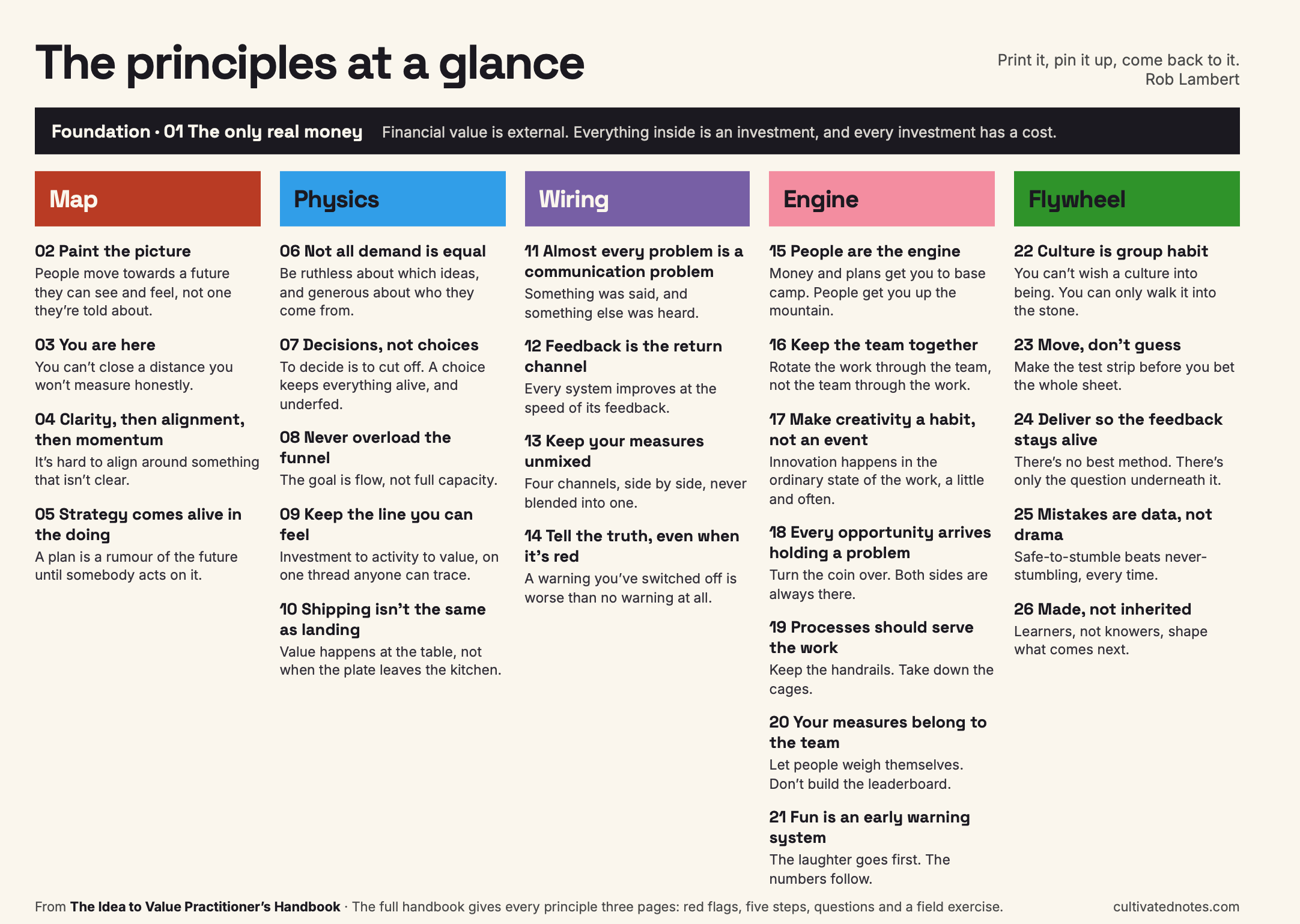
And all the principles fit on a single page.
Whilst you've still got it
This is the part that matters most to me.
Organisations invest money. People invest life: time, energy and attention.
You can make more money. You can buy another notebook, start another project, change the plan. You can't get back Tuesday afternoon. Or the years a talented person spent somewhere that didn't think to ask what they could do.
That's why the second question matters. Not because work should be easy. Hard things are often the best things. But the time we spend making something should give something back. We should come out of it more skilled, more experienced and more ourselves.
Do something worthwhile with what you've got, whilst you've still got it.
So, what are you going to make of it?
You've probably got something in mind already. An idea you keep coming back to. A team with more in it than anyone's using. A skill that's gone a bit rusty. A working life that could be more than it is. A spare hour on a Sunday.
It's more than it looks.
Make something of it.
Where to go from here
Bring it to your team
Work on your own stuck ideas, with your own people. A workshop for the whole team, or one hour online on one initiative.