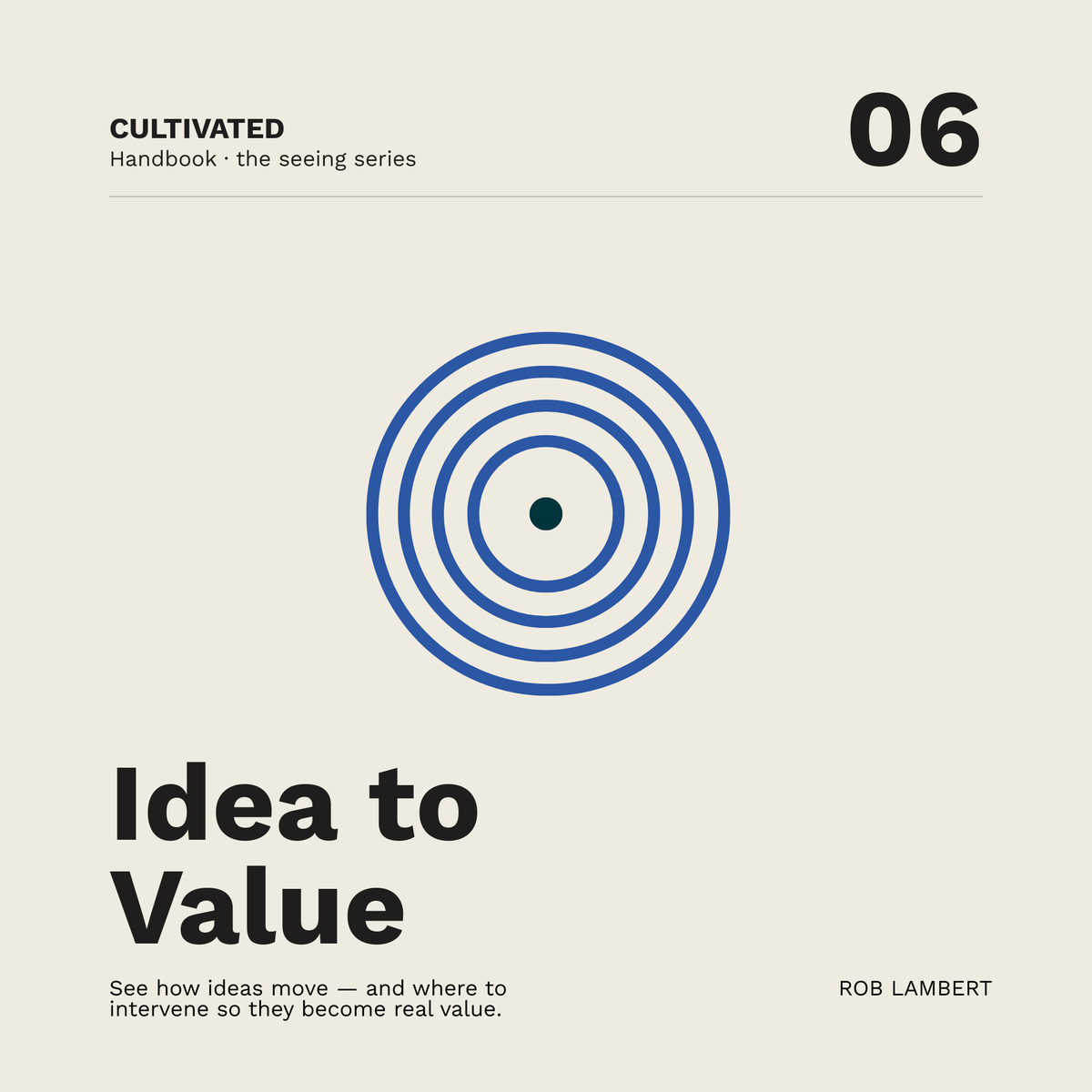
The Idea to Value Handbook
The Life of an Idea shows you why work gets stuck. This is the handbook for getting it moving: 26 principles as working tools, from twenty years of doing it for real.
You can see it. The initiative that's been "nearly there" for two quarters. The team carrying four priority-ones. The dashboard that's green while everyone in the room knows it isn't. And now someone's asked you to sort it out, on Monday, with the people and budget you've already got.
The Life of an Idea helps you see why work gets stuck. This handbook is for what comes next. It takes the same principles and turns each one into a working tool: what to look for, what to do first, and the questions that tell you whether it's working.
The Practitioner’s Handbook · yours with Studio
The handbook for getting stuck work moving.
Twenty-six principles, each with red flags to spot, an example, five practical steps and the questions that tell you it’s working. Download it the moment you join Studio.
- 26 principles
- 5 steps for each
- 86 pages
- PDF, print what you need
- £5 a month or £50 a year · cancel any time
What you'll be able to do
01
Diagnose it in an hour
Walk a stuck piece of work against the red flags and name what’s really in the way, with evidence rather than opinions.
02
Make the case
Trace investment to activity to value, write the problem and the opportunity in one line, and take a decision people will back.
03
Change how the team works
Limit what’s on the go, keep teams together, separate the measures and make it safe to report red. Five steps at a time.
04
Keep it going
Shorter feedback loops, small tests instead of long debates, and retrospectives that turn into real change.
From seeing to doing
The Life of an Idea tells each principle as a story, so you can see it. The handbook takes the same principle apart, so you can use it: in a one-to-one, a planning session, a leadership away day or a client engagement. Every principle is built the same way, so once you've used one, you can use them all.
It isn't a methodology. There's no programme to roll out and no framework to adopt. It's twenty years of what worked, written down plainly enough to adapt to your own team, whatever its size.
Every principle, the same eight parts
- 01The principleWhat it is, in a paragraph.
- 02Why it mattersThe cost of ignoring it, in plain terms.
- 03When it works, and when it doesn’tWhat good and bad look like on an ordinary day.
- 04Red flagsThe signs to look for in meetings, reports and teams.
- 05An exampleA real organisation, what changed and what happened.
- 06Five stepsWhat to do, in order, starting this week.
- 07Reflection questionsFor you, your team, or a client conversation.
- 08The takeawayFive lines to carry into the room.
A principle, in full
Here's one, almost exactly as it appears in the handbook.
Watermelon reporting is when everything looks green on the outside and is bright red inside: reports, dashboards and updates all say “on track” while delivery, value or morale slip. Real progress starts when honest data and open conversation replace false confidence.
Red flags
- Everything is green, yet people are surprised by sudden crises.
- Reports written to please executives, not improve the work.
- Manual reporting that filters out uncomfortable truths.
- Resistance to automating data because “it’ll make us look bad”.
Reflection questions
- Where does watermelon reporting happen most often here?
- How could we make it safer to share bad news or ask for help?
- Are our reports showing the truth, or a performance?
Five steps
Step 1
Audit your reporting
Find where updates look healthy and reality doesn’t match.
Step 2
Automate the truth
Pull data from the systems of record, not the slide deck.
Step 3
Two kinds of feedback
Pair progress and cost with wellbeing and customer value.
Step 4
Reward honesty
Make red a request for support, never a punishment.
Step 5
Narrative, not spin
Use the data to tell what’s really happening and what’s next.
Example. A large government programme reported everything green until the final quarter, when several “green” projects came apart at once. Teams had been afraid to mark themselves red. Once dashboards fed from real delivery data and leaders publicly thanked teams who raised problems early, delays fell by 40% within six months.
The takeaway. Real data beats curated dashboards. Reward honesty. Data should inform decisions, not disguise reality.
This has done real work
Every principle in the handbook was shaped in practice: first growing an engineering team inside a start-up as VP of Engineering and then VP of HR, then a decade of consulting with organisations of five to sixteen thousand people.
From the work behind it
Every 14 months → weekly
Releases, while an engineering team grew from 6 to more than 200.
+53% · −23%
Delivery capability up and operating cost down, in a regulated payments turnaround.
1,000 initiatives
A portfolio run at more than 60% delivery effectiveness, later the blueprint for a 16,000-person technology organisation.
300+
Idea to Value workshops and sessions, including three cohorts of 150 at a global energy company.
And from the examples inside: a 40-day funding approval cut to 3; stable teams that lifted delivery, quality and happiness within a year; a velocity league table that, once scrapped, stopped rework eating 30% of everyone’s week.
What's inside
Twenty-six principles in the five layers of Idea to Value, with an introduction to the idea-to-value journey, a shared vocabulary for your team, and a closing section on putting it all into practice.
The Map
Direction
Paint a future people want to walk towards, be honest about where you are, and clear a path: clarity, then alignment, then momentum.
The Physics
How work moves
Filter demand, make real decisions, limit what’s on the go, connect funding to activity to value, and follow work past shipping until it lands.
The Wiring
Communication
Treat communication as the work, shorten feedback loops, keep your measures separate and make it safe to report red.
The Engine
People and climate
The right people, stable teams, creativity as a habit, processes that serve the work, measures owned by the team, and listening for the room going quiet.
The Flywheel
Habits that compound
Culture as group habit, testing instead of guessing, delivery that keeps feedback alive, and mistakes treated as data.
Who it's for
The people who have to make it happen: managers and team leads, delivery, product and programme leads, heads of function, founders and operators, HR and transformation people, and consultants and coaches who want a clear, honest structure to use with clients. It works for a team of one and an organisation of thousands, because the journey from idea to value is the same shape at any size.
It isn't for anyone looking for a methodology to roll out, a certification or a tool to buy. It asks you to think, adapt and try things in your own context. That's the point.
Questions people ask
Do I need to read The Life of an Idea first?
No, but they work best together. The Life of an Idea (£5.99) tells each principle as a story, so you can see it. The handbook gives you the tools to act on it. They share the same 26 principles.
How do I get it?
Join Studio and the handbook is yours to download straight away. Studio is £5 a month or £50 a year, and you can cancel any time. It also brings the monthly Department of Interesting Things, seminars and working notes, a direct line to me, and 10% off every field guide.
Do I keep it if I leave Studio?
Yes. Once you've downloaded the PDF, it's yours.
Can I use it with my clients or my team?
Yes. Use it in your sessions, workshops and conversations. Please don't share or resell the PDF itself. If you'd like to take a whole team through it, that's the Idea to Value Workshop.
Twenty years of getting ideas moving, in one handbook.
Join Studio, download the handbook, and take one principle into Monday. The red flags show you where to look, and the five steps tell you what to do first.
PDF · 86 pages · 26 principles · print what you need
Written, designed and published in Great Britain by Cultivated · Set in Space Grotesk and Inter
Go further
For a team, the Idea to Value Workshop works through the handbook on your own work, in three hours or a full day. For one stuck idea, book an Idea to Value Office Hour (£200). For the story behind every principle, read The Life of an Idea (£5.99).