The most useful thing a team can learn to see together
Every idea starts in someone's head and, if things go well, ends up as something other people are genuinely glad of – a product a customer loves, a campaign that lands, a service that makes someone's day easier, a better business to work in.
Between those two points there is a journey the original idea travels. Most teams have never seen it whole. They see their own stretch of the road, and trust the rest takes care of itself. It rarely does.
This day gives them that view – not by handing anyone a method to adopt, but by teaching a whole group to see the same thing at once: how their ideas actually move from a spark to something of worth, and what helps or hinders them on the way. It's the widest view most people are ever offered of the work they spend their lives inside. Once a room shares it, the way they talk, decide and prioritise begins to change on its own.
And here's the part that surprises most people: the journey has the same shape whether you're a design studio of twenty or a technology function of sixteen thousand. A novel, a campaign, a platform, a small business run from a kitchen table — same road. Learn to see it once, and you start to see it everywhere.
Why this matters, on both sides
The journey is worth seeing for two reasons, held together.
The business one is obvious once you name it. Organisations succeed when good ideas become valuable things – products people buy, work customers come back for, decisions that pay off years later. When ideas leak away on the road from spark to value, so does the return on everything spent to have them in the first place. Most organisations don't have an idea problem. They have a problem with what happens to those ideas between spark and value – and it costs them more than they know.
The other reason is more subtle and harder to price, but it's the one that matters most for the people in the room. Careers grow in the exact places where people can see their own work becoming valuable — where they know what they're contributing, why it matters, and how their part fits into the whole. When the journey is invisible, so is the contribution. People tend to disengage at work, or their growth slows, not because they're not capable, but because they can't see the shape of what they're doing well enough to grow through it. Show them the whole road, and the growth follows.
One shared way of seeing
Idea → Invest → Creative Action → Ship → Value
That's the path every idea travels, and the day walks it together using work your people can name and care about, so it never stays abstract. We cover the four different types of value an organisation is typically chasing, how everyone in the organisation is working in their own flow of idea to value, why they often compete, and why reducing the gap between having a spark of an idea, and the value at the end, is how we shrink costs, increase learning and grow through it.
But the path is only half of it.
Around it sits the terrain — five layers, or ways of looking at a system, that decide whether an idea moves cleanly, loses its value along the way, becomes something else, or gets stuck entirely. The day introduces all five, in plain language, applied to your room.
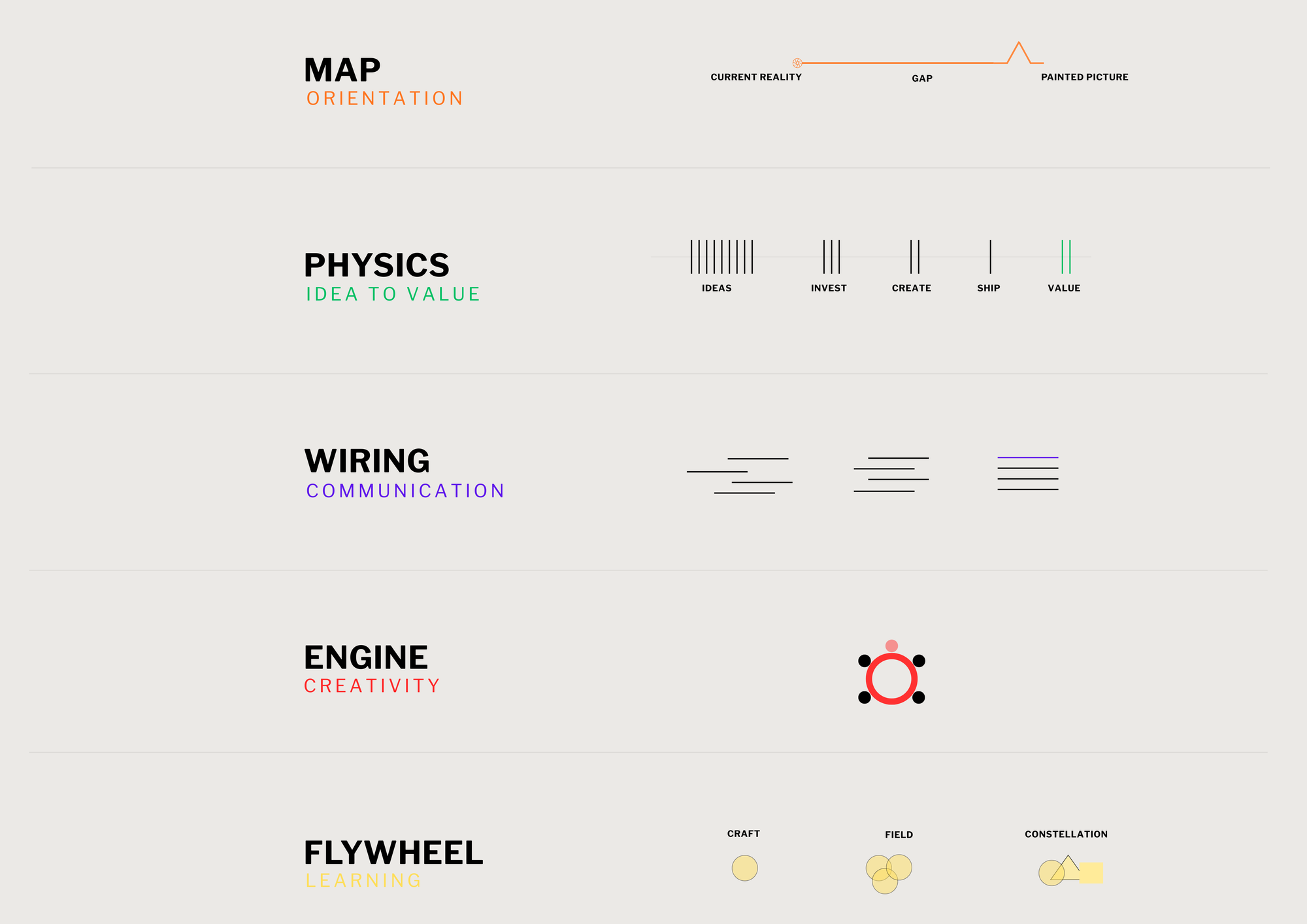
Map — Orientation. Knowing which way value actually is before anyone sets off, and making sure the work is connected to the direction of the business. Without the map, effort scatters. With it, decisions get simpler.
Physics — Idea to Value. How ideas move, gather momentum, and where value leaks out on the way. This is the layer that names the road itself — where ideas start as a wide field of possibilities and narrow, step by step, into the few that become real.
Wiring — Communication. How understanding travels between people, or doesn't. Most of what looks like a strategy problem or a delivery problem turns out to be a communication problem — the same idea in different heads, meaning different things.
Engine — Creativity. The conditions that let good work happen, and the people who are the real engine of all of it. Creativity isn't a personality trait; it's a climate. Change the climate and what people are capable of changes with it.
Flywheel — Learning. What keeps good work moving long after the session ends, and grows the ability of the room through it. The layer where a single insight becomes a repeatable practice, and where a team gets better at doing this because they've done it before.
The way of seeing stays constant. The application is always yours. And what you see is where the work is.
Run on your real work, not case studies
Everything in the session runs on your organisation's actual work — the projects in flight right now, the ideas your people are carrying, the thing that shipped last month. No fictional companies, no borrowed case studies, no standardised examples.
The principles applied to someone else's business is interesting. The same principles applied to the idea your team has been working on for months is the one they remember.
A short conversation beforehand tells me where the work is most alive for your group — and the day gets built around those specifics.
What people leave with
Each person leaves able to look at any piece of work and see where it is, what it's for, what it needs next, and how to help it along — and asking sharper questions of their own work without being prompted.
They leave with a shared language, which is the thing that compounds. It changes how a team prioritises, how early someone names a problem while it's still small, and how well people who used to talk past each other now work together.
And they leave with something rarer: a sense that more of their good ideas — and more of the care and effort they pour into them — can actually make it into the world, instead of leaking away unseen. That feeling has a name worth borrowing. Mottainai — a respect for the worth of a thing, and a wish to see its potential realised rather than wasted. This day is that idea, made practical.
Why it works for any size or mix
The mix in the room is a feature, not a problem to manage. Finance, design, operations and delivery each see the work through the lens their role gave them — and each lens is real, and shows something the others can't. The day gives the whole group one picture to look at together, so those views add up rather than compete.
A surprising amount of cross-functional friction turns out to be capable people looking at different parts of the same thing with no shared picture. By the afternoon, they have one.
It has run for studios of a dozen and programmes of forty, and the conversation is always specific to the people in the room. Fit matters more than size.
Who tends to get the most from this
Leadership teams who suspect their organisation is capable of more than it's currently shipping, and want to know why. Cross-functional groups where the different parts of the same journey have never actually sat in one room together. Product and delivery teams who know they're busy but aren't always sure the work is landing where it should. Studios and small businesses where the whole team can be in the room at once — a rare thing, and one of the most powerful configurations this day runs in.
The day is a poor fit for organisations looking for a methodology to roll out, or a change programme to launch. It doesn't come with a certification track, a set of tools to procure, or a follow-on engagement waiting in the wings. If what you want is a system to install, this isn't it. If what you want is your people to see their work differently by the end of the day, and to carry that seeing into everything they touch afterwards, this is exactly it.
Making the day into something the team keeps
This workshop can include an optional making element — where the shared map the team drew on the day becomes something they keep and return to.
The most natural shape: a printed reference set of the team's own journey — the five layers, the specific applications for their organisation, the language they agreed on — for the meeting-room wall. A more ambitious version: a short film of the day capturing the moment the room saw the road whole, edited for onboarding or wider leadership. Or a podcast episode with two or three participants reflecting on what shifted.
Optional, scoped in the initial conversation, and priced separately. It grew out of the wider Cultivated practice — the films, the photography, the publishing — and it's where the teaching arm meets the making arm.
How the day works
A full day, in person where possible, for groups of roughly eight to forty. Designed and led by Rob Lambert, creator of the Idea to Value system and long-term student of how ideas become something valuable.
A pre-session conversation tailors the day to your work. Everyone leaves with materials and a simple reference map for the journey and the five layers. International delivery on request.
Where this sits in the wider practice
The Whole Journey is the workshop version of a body of work that also exists in other forms, for people and organisations that want to go deeper on their own time.
The Life of an Idea is the accessible field guide to the journey — a book that takes the same territory the workshop covers and lets a single reader walk it at their own pace. Useful preparation before a workshop, useful reinforcement afterwards, and a good first step for anyone curious about the thinking before booking a day.
The Idea to Value Handbook is the practitioner's version — twenty-six principles that sit underneath the system, written for people who want to work with the method themselves and apply it inside their own organisation over time. Available inside the Studio.
Both books are optional; the workshop stands on its own. But for organisations that want the seeing to keep growing after the day, they're the natural next steps.
About Rob Lambert
I'm Rob. I've spent twenty years inside organisations – as VP of Engineering, VP of HR, Head of Business Agility, and independently – studying how ideas become value, and where they don't. Long enough on both sides of the wall to know that the results a business needs and the growth its people deserve aren't separate subjects.
Nothing borrowed, nothing installed. Just what I've seen hold true across teams of one, six, and sixteen thousand.
More about the wider practice →
Start with a conversation
Get in touch
A twenty-minute call. No pitch, no pressure, no follow-up sequence.
A chance to talk through what your team is working on and whether this is the right day, the right group, and the right moment. If it is, we'll shape it together. If it isn't, I'll say so and point you somewhere better suited.