From Idea to Sustainable Work
A field guide for independent creators. Twenty principles, each told through a story, for the space between having an idea and earning from it.
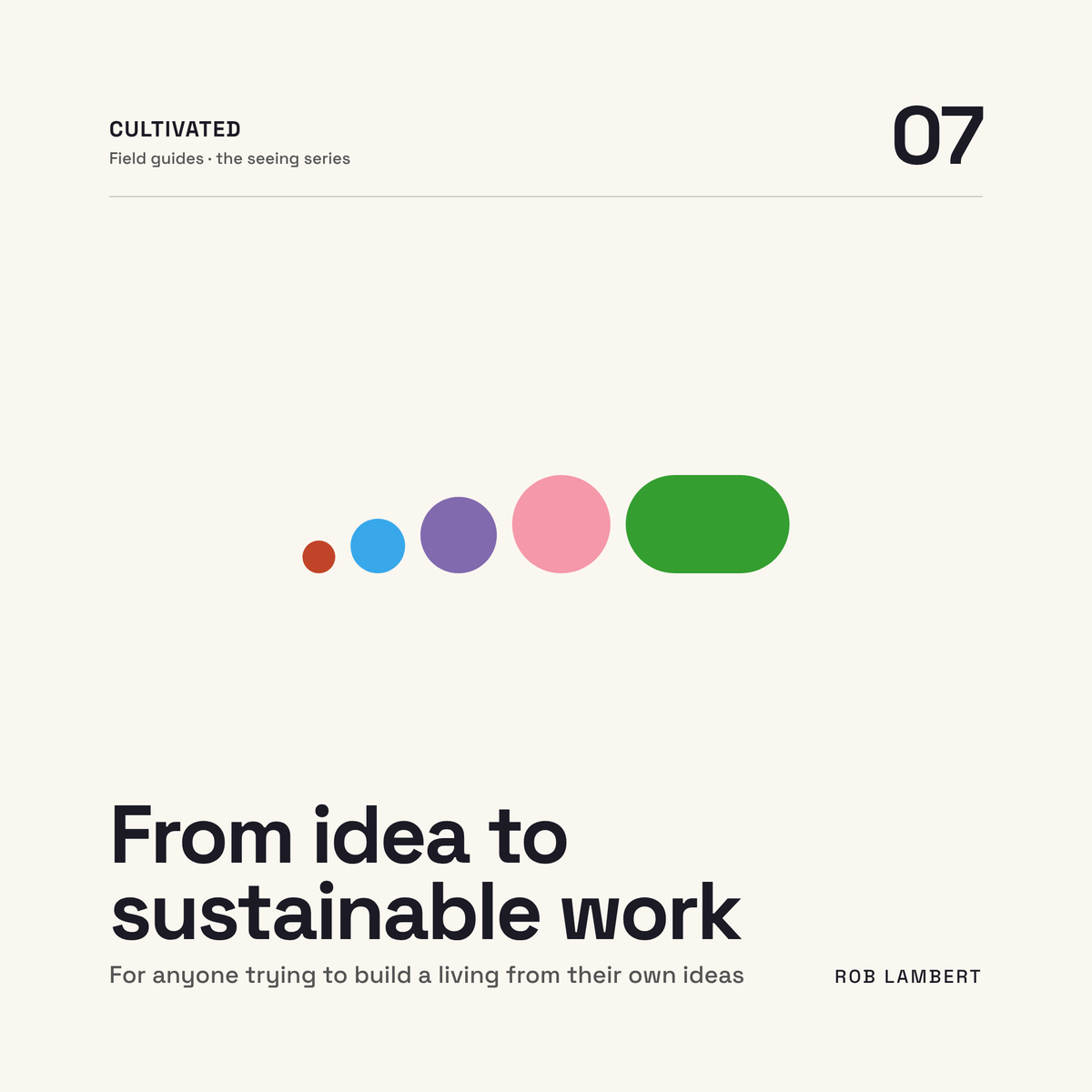
A field guide for independent creators. Number 07 in the seeing series, revised for October 2026: fifty-nine pages, twenty principles, one frame.
You publish the thing you've been working on for weeks. You refresh the page. A few likes. One kind comment from a friend. Then not much at all.
Almost every independent business starts like this. You have an idea, you make something, you share it and you wait. Many people stop here, not because they lack talent, but because they expect certainty too soon.
From Idea to Sustainable Work is a companion for that stretch: the space between having an idea and earning from it. It's for people building something of their own, whether that's a newsletter, a podcast, a product, a small studio, a consultancy or a book. Inside are twenty principles, each told through a short story and followed by something you can use this week: red flags to look out for, questions to ask, steps to improve and something to try in the field.
No. 07 in the seeing series · Revised edition
From Idea to Sustainable Work
Twenty principles for independent creators, each told through a story, with something to try this week.
- £5.99, one purchase
- 59 pages
- 20 principles
- 5 layers
- A4 landscape PDF
An investment in your own potential
Every idea you choose to work on asks something of you: time, energy, attention, sometimes money. It's tempting to treat all of that as cost, a bill that keeps growing until revenue arrives to settle it. That's honest about the numbers, but it misses what's happening to you while you pay.
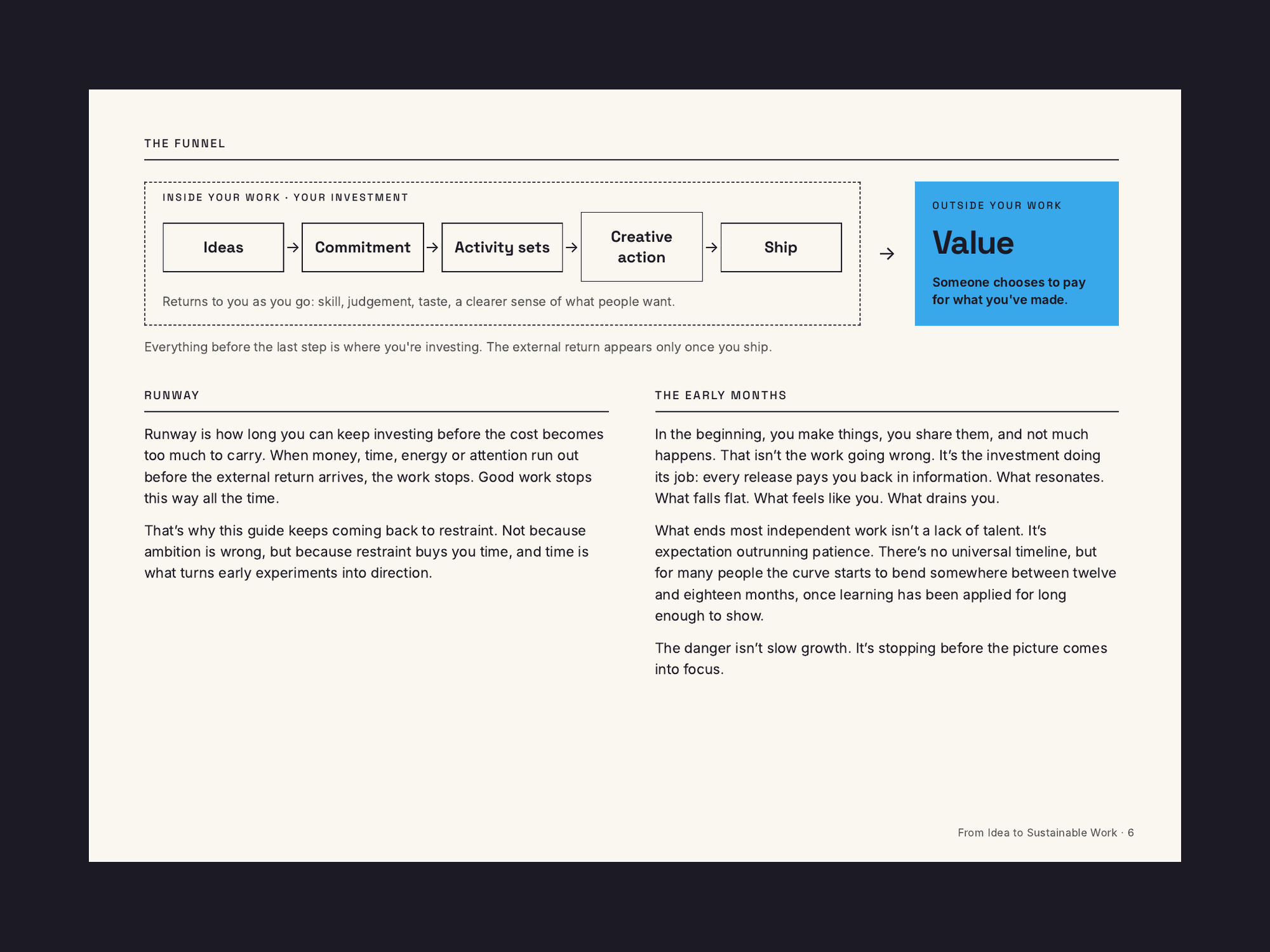
Each draft, episode, prototype and offer builds something in you: skill, judgement, taste, a clearer sense of what people want from you. That return stays with you whether or not this particular idea earns. The other return comes later, when someone outside your work chooses to pay for what you've made. You need both, and the guide starts there, with one frame that everything else sits on.
The frame the guide sits on
Everything you put in builds you. It still has a cost.
Every stage before someone pays is an investment in your own potential
External return
Someone chooses to pay
For what you've made. That's the return that keeps the work going.
Internal return
What you learn and who you become
It arrives early and it compounds, and it still costs time, energy and attention.
Stay in the game long enough
Runway is how long you can keep investing before the cost becomes too much to carry. When money, time, energy or attention run out before the external return arrives, the work stops, and good work stops that way all the time. That's why the guide keeps coming back to restraint: commit lightly, ship small, be effective before you try to be efficient, and earn every upgrade.
What ends most independent work isn't a lack of talent. It's expectation running ahead of patience. The danger isn't slow growth. It's stopping before the picture comes into focus.
What's inside: five layers, twenty principles
The principles are grouped into the five layers of Idea to Value, from where you're heading through to the learning that compounds. Read it straight through once, then dip in wherever your work needs you.
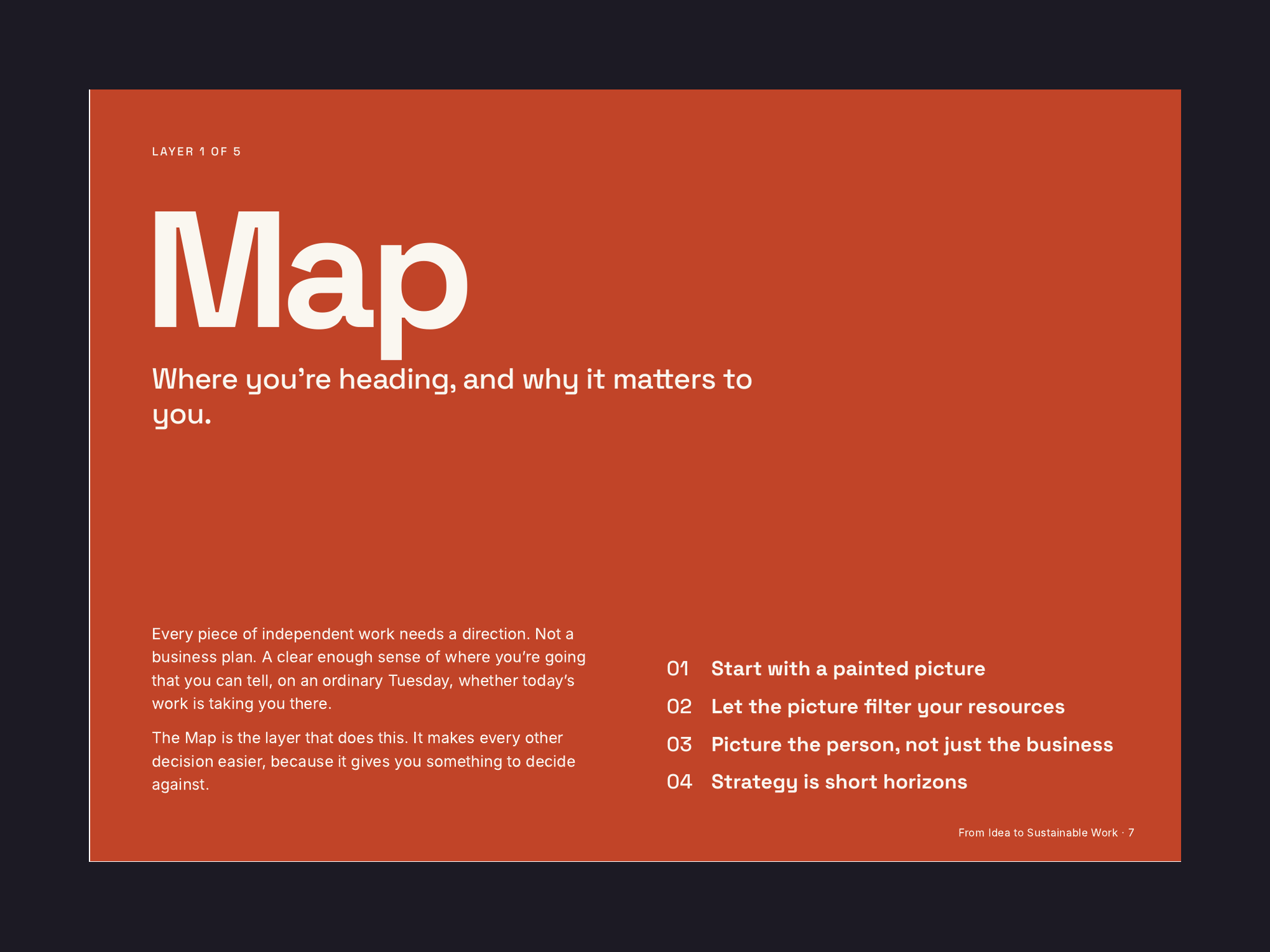
Map
Direction
- 01 Start with a painted picture
- 02 Let the picture filter your resources
- 03 Picture the person, not just the business
- 04 Strategy is short horizons
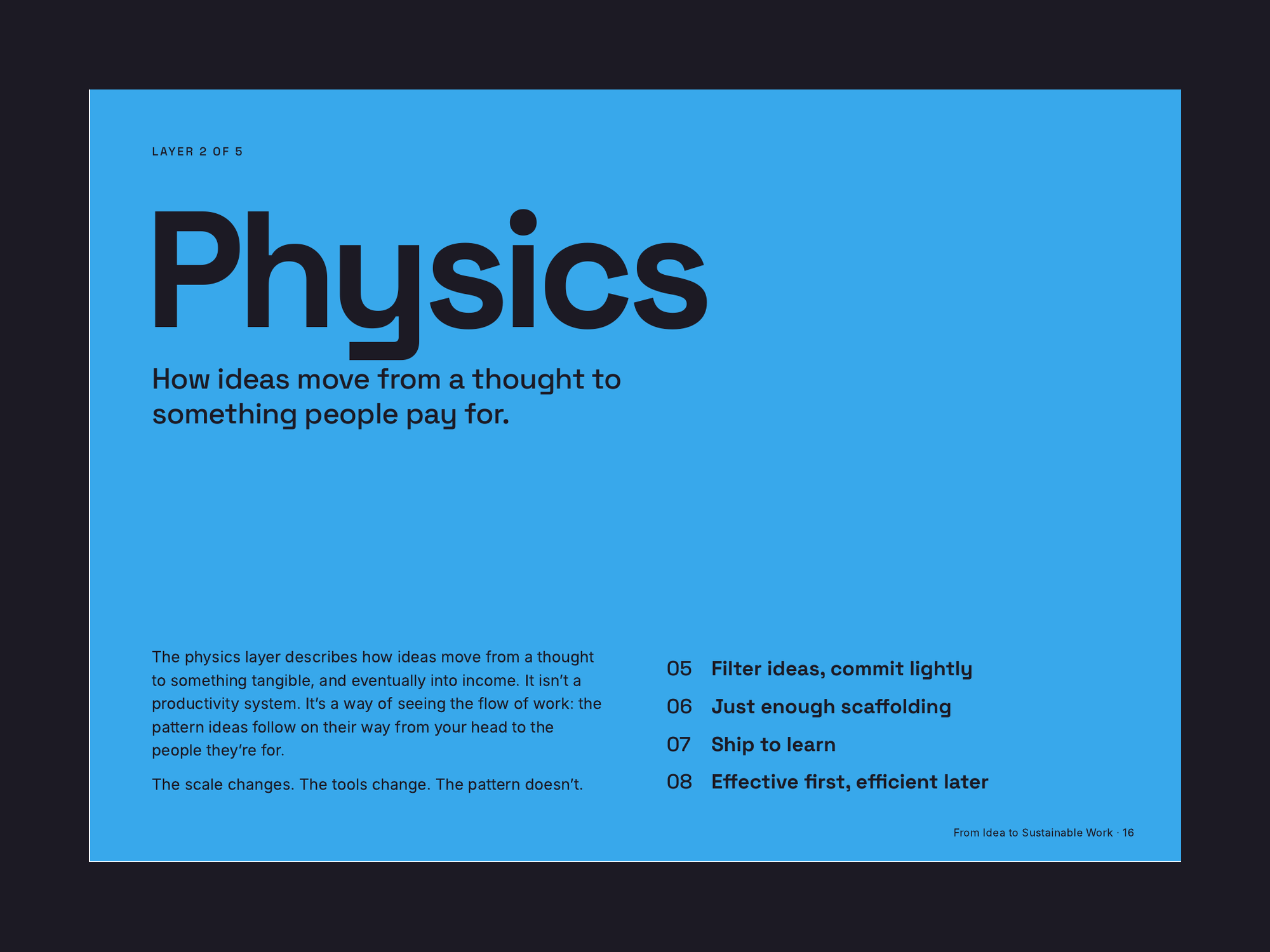
Physics
Ideas and value
- 05 Filter ideas, commit lightly
- 06 Just enough scaffolding
- 07 Ship to learn
- 08 Effective first, efficient later
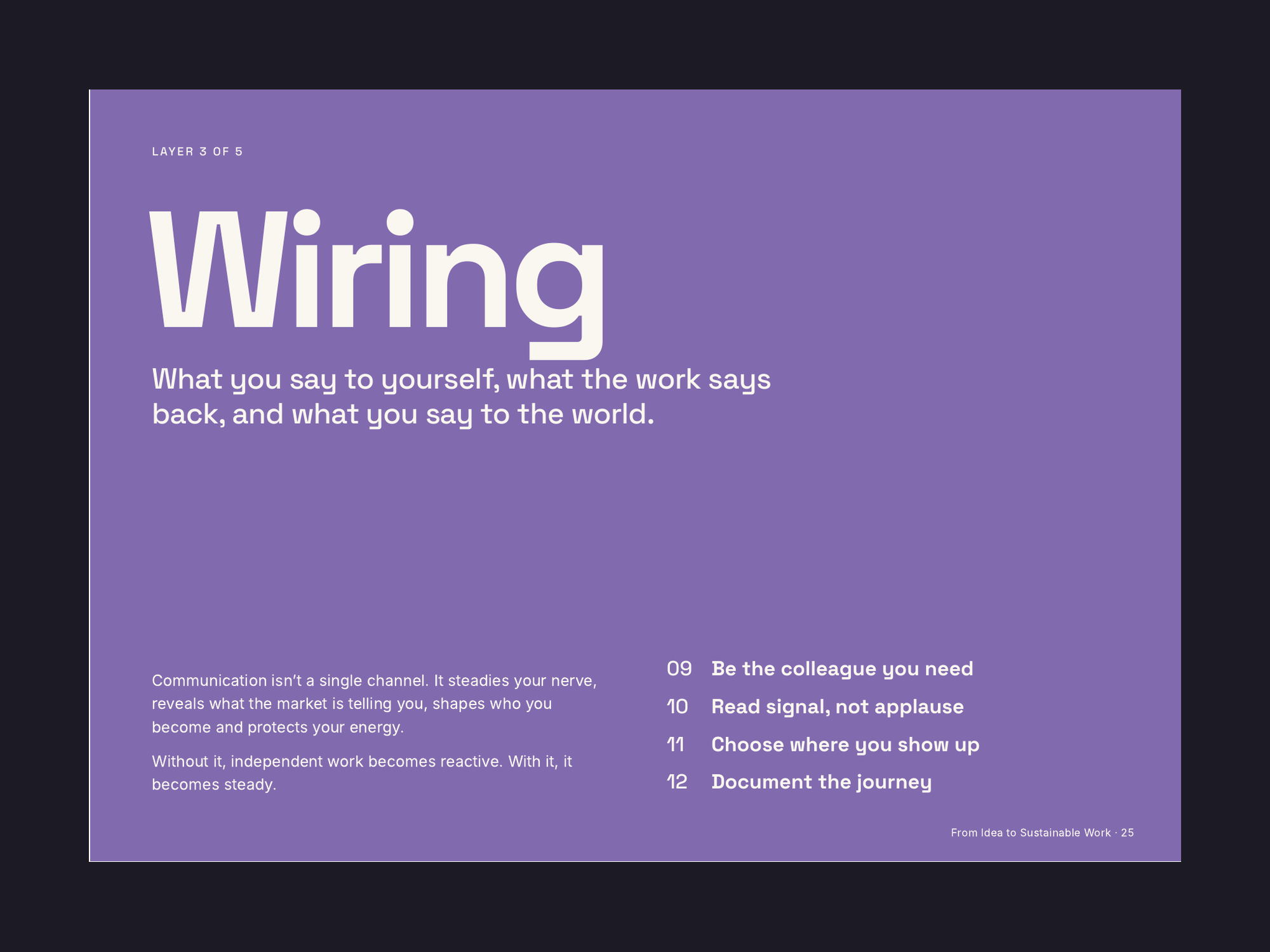
Wiring
Communication
- 09 Be the colleague you need
- 10 Read signal, not applause
- 11 Choose where you show up
- 12 Document the journey
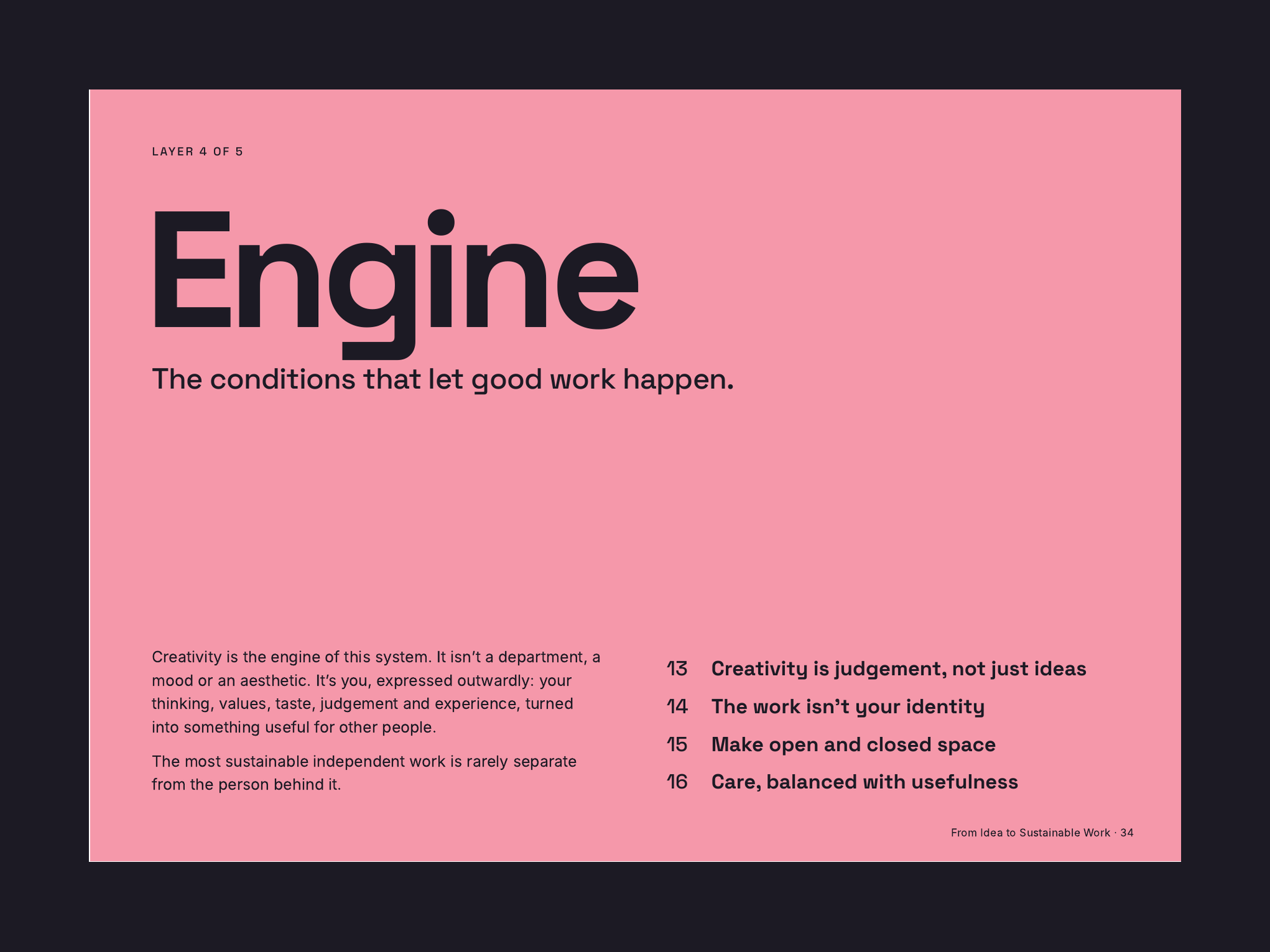
Engine
Creativity and climate
- 13 Creativity is judgement, not just ideas
- 14 The work isn't your identity
- 15 Make open and closed space
- 16 Care, balanced with usefulness
Flywheel
Learning
- 17 Learn what removes the bottleneck
- 18 Pause to see
- 19 Earn the upgrade
- 20 Optimise friction, not ego
Every principle, introduced through a story
Guides for creators tend to read like checklists. This one doesn't. Each principle opens with a story, most of them from my own work: a podcast whose first episode didn't record, an over-engineered video setup, a backlog of good work that went nowhere in particular, a lottery question that turned out to describe the job. The second page then gives you something to do.
Page one
A story
“The first episode didn’t record, so we recorded it again. A few hundred people downloaded it. Neither of us had known there was an audience for two people talking about notebooks and pens. We wouldn’t have found that out by planning. Only shipping told us.”
From 07, Ship to learn. Each story ends with what it means for you.
Page two
Something to do
- Red flags to look out for
- Questions to ask yourself
- Five steps to improve
- When it works, and when it doesn’t
- In the field: something to try this week
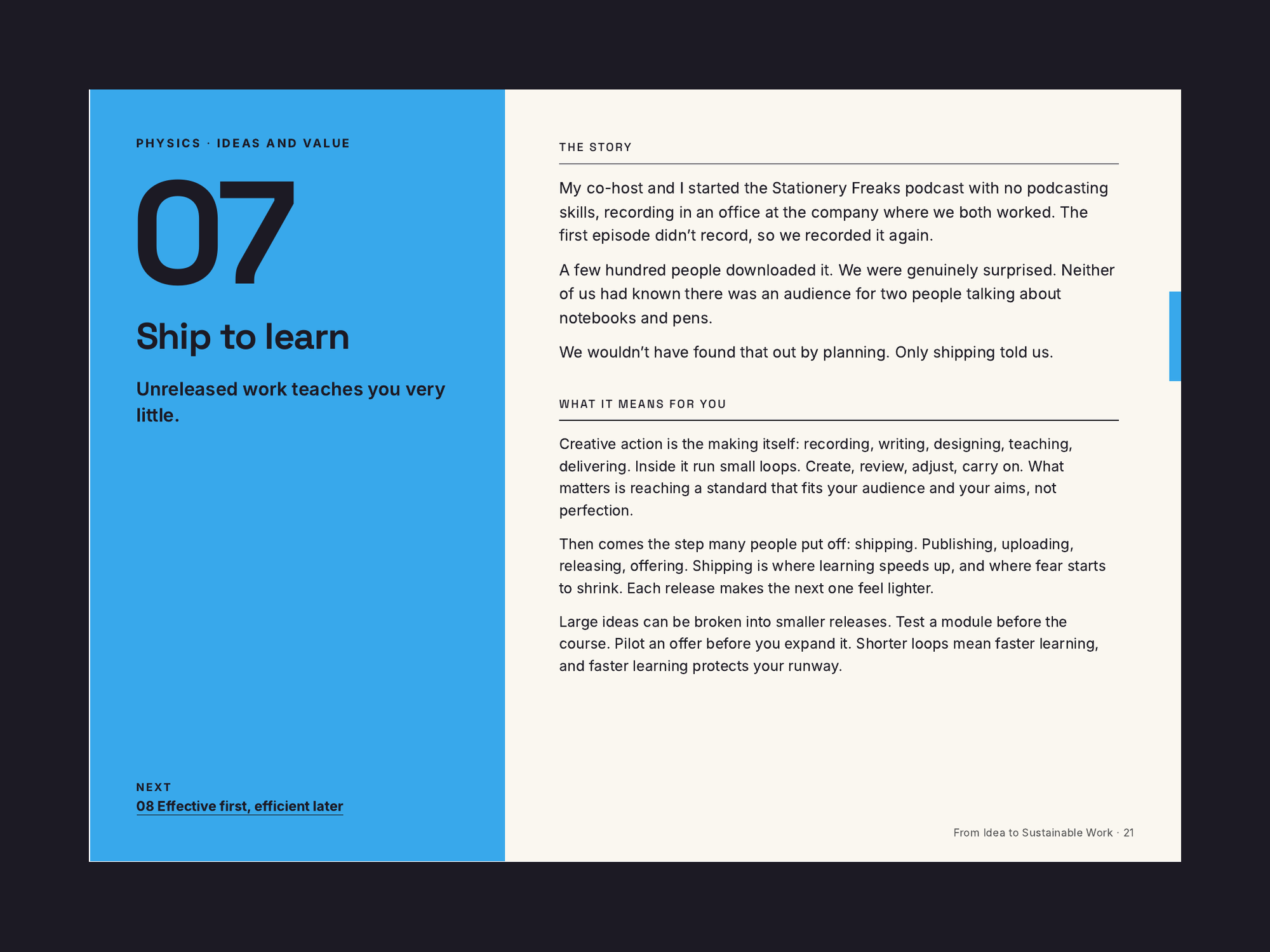
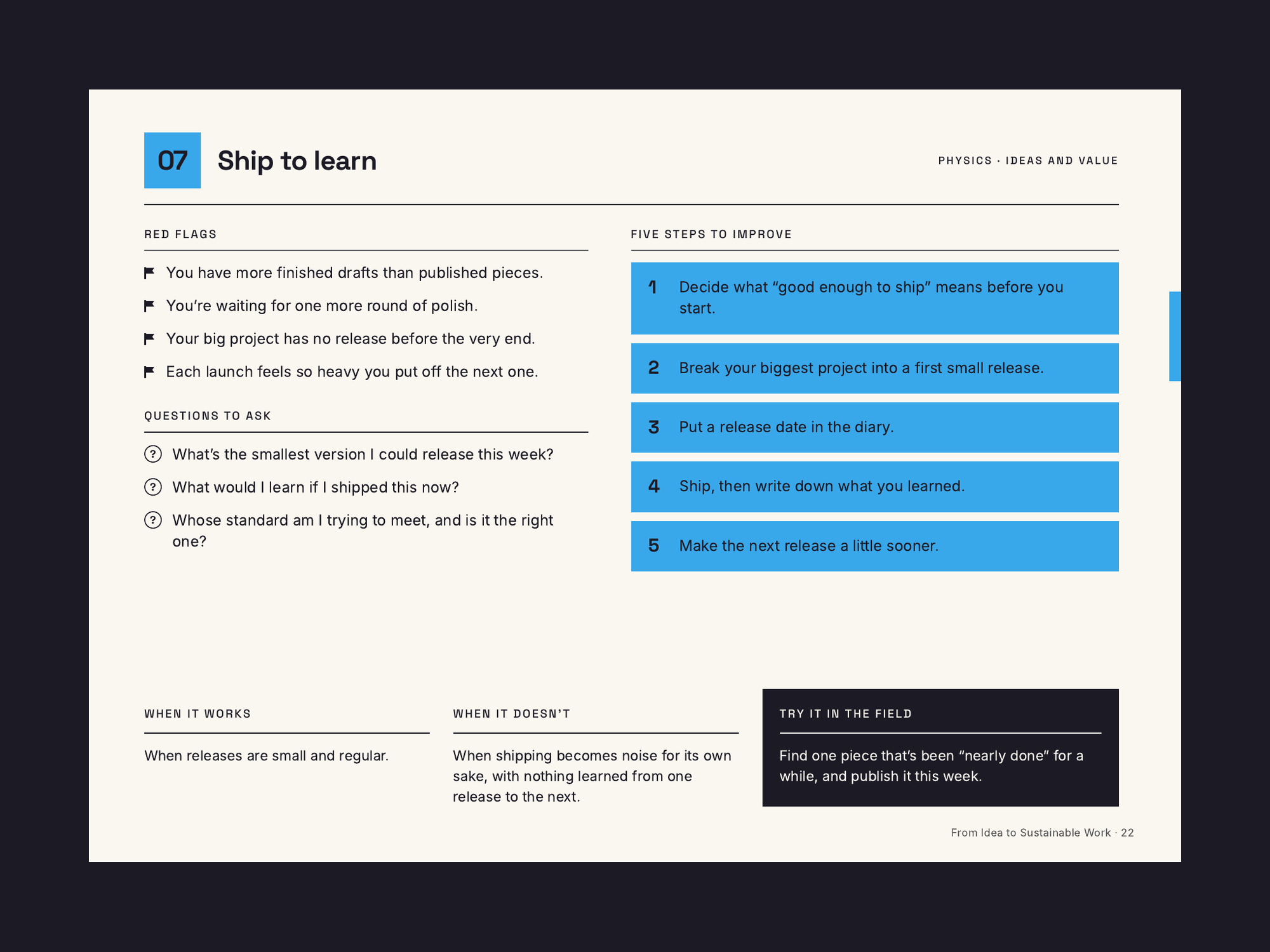
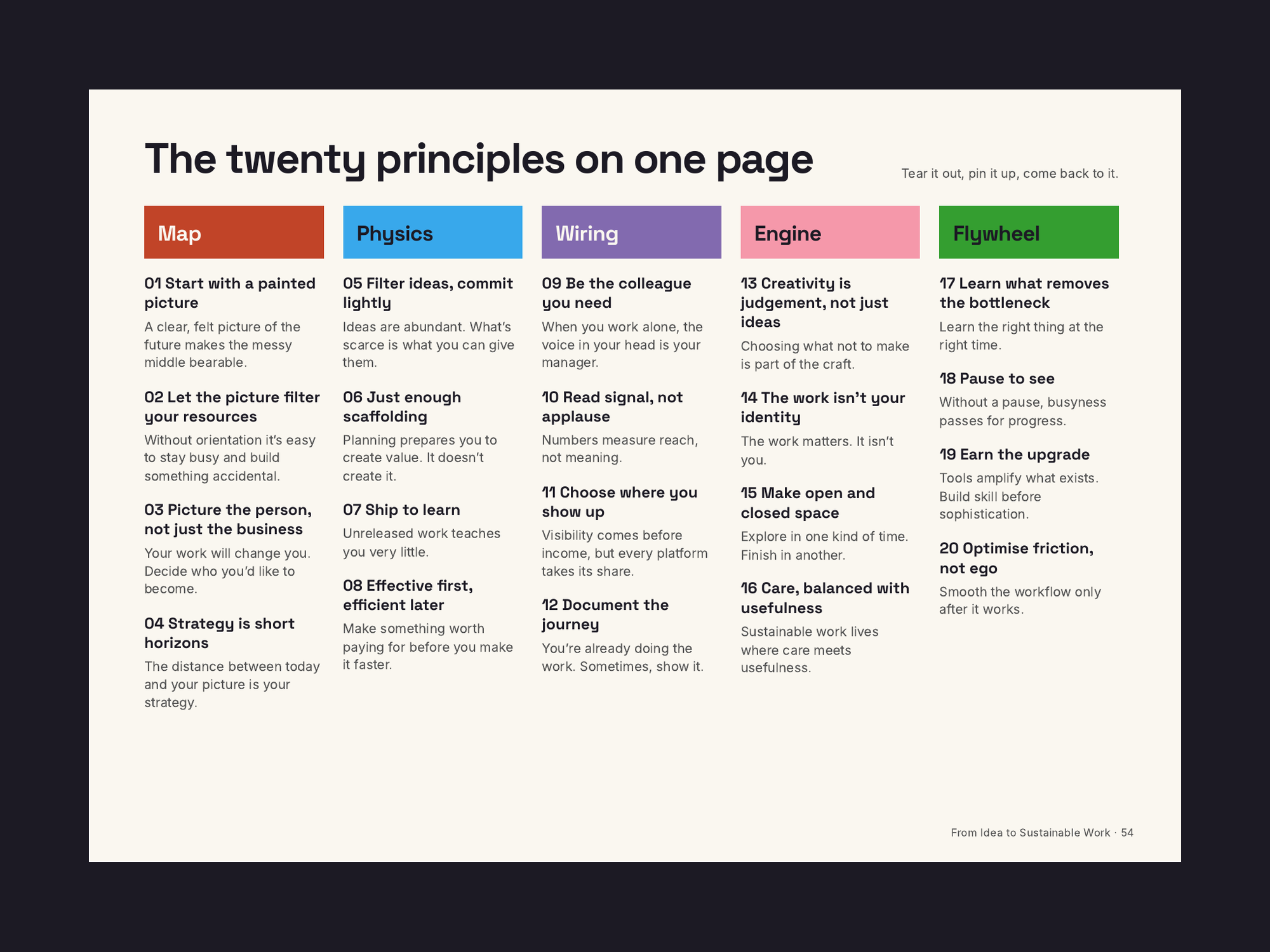
Images from the Idea to Sustainable Work Guide
A week in the life
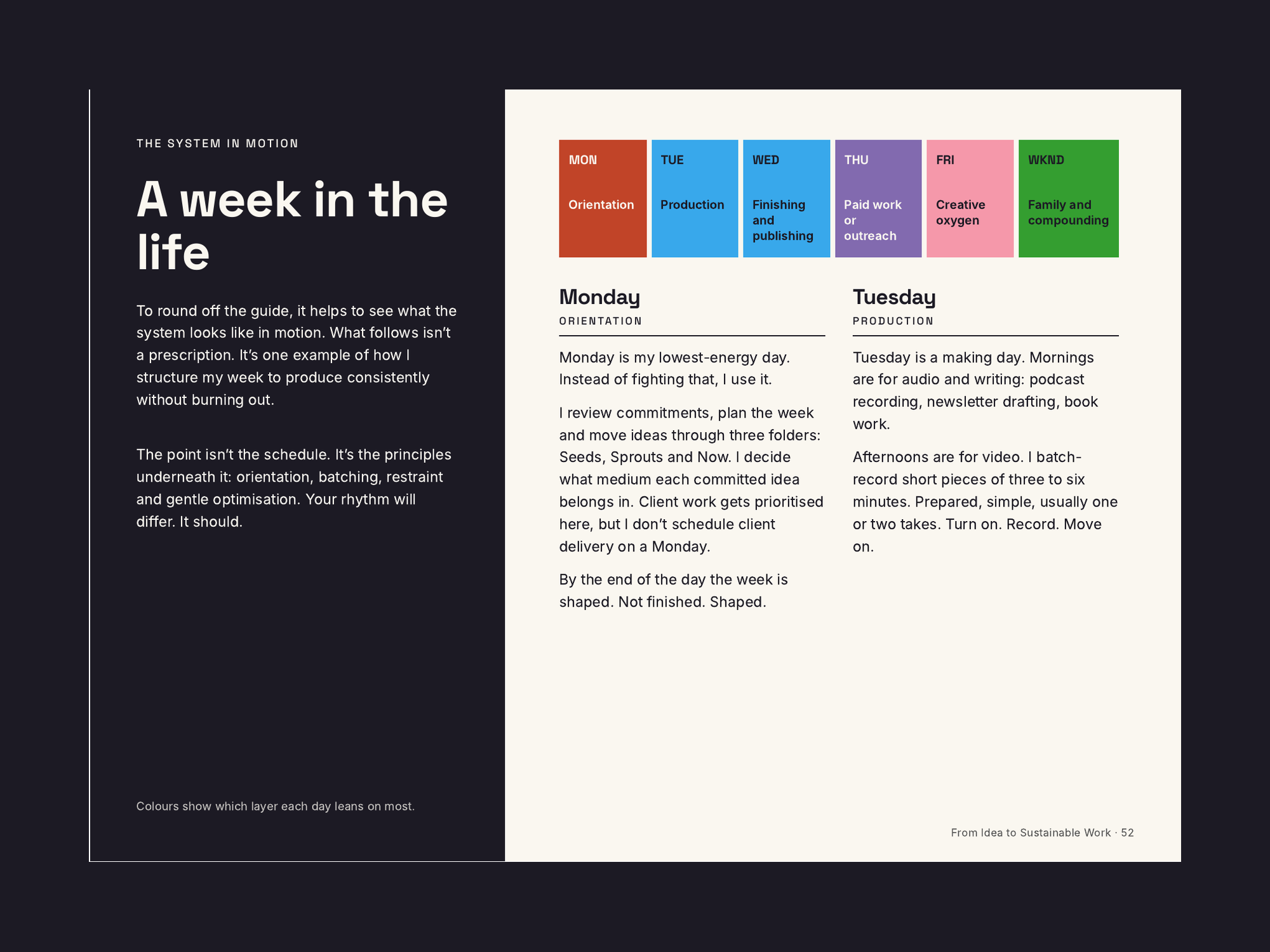
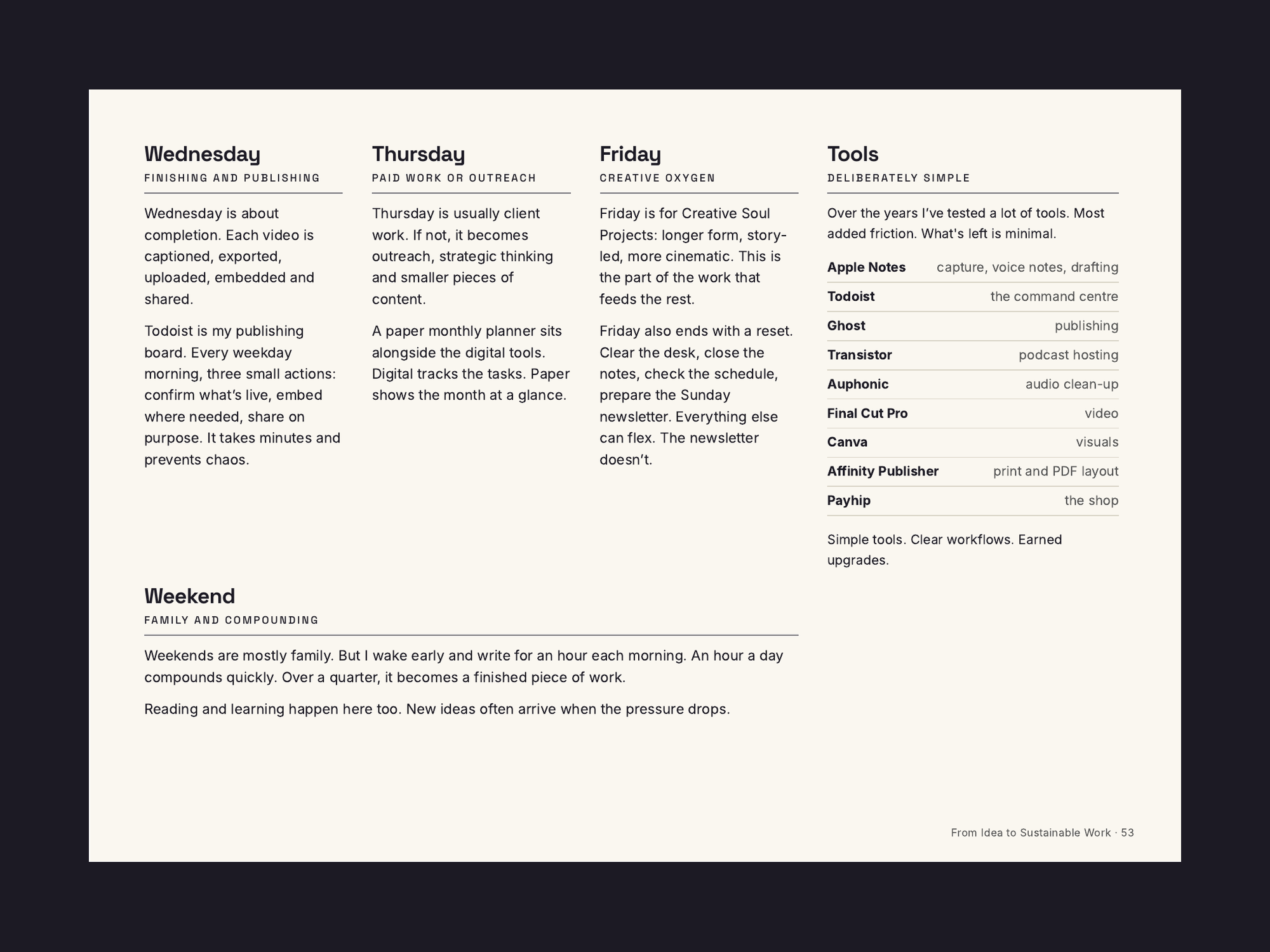
The guide ends with one real week: how I shape the work from a low-energy Monday spent on orientation to an early hour of writing at the weekend. It isn't a fantasy morning routine. It's a real life, with work inside it, and the principles running underneath: orientation, batching, restraint and gentle optimisation. Your rhythm will differ. It should.
Who it's for
It's written for anyone building a living from their own ideas: writers and newsletter publishers, podcasters, designers and makers, consultants and coaches, course creators, and people running a small studio or shop. It works whether you're testing ideas around a full-time job or you've already gone all in. The label doesn't matter. What matters is that you'd rather build something sustainable than chase the next piece of internet advice.
Not a hustle guide
Most of what I write is about making work better for the people who still have to turn up to it. This guide is for the people building that work for themselves. It shares the same way of seeing. There are no growth hacks or overnight formulas here, and no pressure. Just a calmer way of seeing how ideas become something real, and repeated invitations to simplify. If you'd like the thinking behind it, start with Making Work Better.
Questions people ask
Is this for me if I still have a job?
Yes. Plenty of people start that way. One of the examples starts with someone in a full-time job they don't enjoy, and the first horizon is a microphone, a simple website and saving towards runway.
How is it different from The Life of an Idea?
The Life of an Idea explores how anyone within a business can take ideas to value more smoothly and effectively. From Idea to Sustainable Work applies it to one situation, building a living from your own ideas, with red flags, questions, steps and something to try for every principle.
Do I need to read it in order?
No. Every principle stands on its own two pages. Start with the frame, then go wherever your work needs you.
About the author
I'm Rob Lambert. I've led software engineering teams, led HR and led communication, and for the last twenty years I've worked with independents while being one myself. I co-host the Stationery Freaks podcast, publish Cultivated Notes from Winchester, and make films, photographs and books. Many of the stories in this guide come from those projects.
The system in depth
The Life of an Idea
How ideas travel, what slows them down and what helps them arrive. The thinking underneath this guide, as short essays.
Explore the book →A working community
Studio
Field guides, essays, experiments and seminars as they develop, and a place to make things alongside other people doing the same.
Join the Studio →Ideas become income. Income becomes independence. Independence becomes choice.
Fifty-nine pages, twenty principles, one frame. A companion for the space between your ideas and their value.
PDF · No. 07 in the seeing series · Revised edition · A4 landscape
More images from the guide
Creative Soul Projects
There's a video that goes with this piece, on Creative Soul Projects. Same person, same observation — just followed on camera instead of on the page. Explore the channel.