Turning ideas into value
How ideas become valuable, what happens to the people carrying them, and the map I use to see the journey.
Does an idea become the value it should, and is it worth being part of?
Some years ago I worked at a startup that ran a hackathon: a day set aside for building things and exploring ideas. Everyone expected code. The team I was working with didn't write any.
A group of colleagues who weren't engineers looked at a day designed for coding and decided to make a book instead. Write it, edit it and publish it before the clock ran out. I was the editor.
By the end of the day there was a real, published digital book, made by people whose job descriptions said nothing whatsoever about writing or publishing. Something that had been a slightly unconventional suggestion that morning now existed in the world.
It remains one of the best days of my working life, because it answered the two questions I've been asking for most of it.
Did the idea become the value it should?
And was it worth being part of?
Yes. And very much yes.
I've also spent plenty of time in work where the answers were less cheerful. Projects that took a year when they could have taken three months. Good ideas that arrived smaller and less valuable than they set out. People doing work that used a fraction of what they had to offer. Teams putting in epic hours on something that probably shouldn't have been started at all.
That's what I've spent twenty-odd years paying attention to: how an idea becomes something valuable, and whether it's any good to be part of the work that gets it there.
An idea is two sightings
Every idea begins with two things seen: something you notice, and something you imagine.
The first might be a queue that's always too long. A form nobody fills in properly. A customer asking the same question for the fourth time this week. A little shop that does one small thing beautifully. Something that made you laugh on the way to work.
The second is a glimpse of what that thing could become. A shorter queue. A simpler form, or no form at all. A customer who doesn't have the problem in the first place. A product, a service, a book, a film, a podcast, a business, a better way of helping someone.
I looked at a day meant for software and saw a book. That moment, noticing something and then briefly seeing what it might become, is one of my favourite things in the world.
That's an idea. That's potential. And once you start looking, it's everywhere.
Then comes the messy middle
An idea starts life in someone's head, where it can feel enormous. Imagine what this could become.
Then you try to make it real.
Suddenly there are other people. Other priorities. Budgets, meetings, habits, politics, misunderstanding, red tape, fear, and usually a slide deck with terrible fonts.
The idea starts to change.
Sometimes it gets better as you refine it. Sometimes its potential is chopped away. Sometimes it arrives exactly as hoped. Sometimes it becomes something nobody quite intended, and nobody quite wants.
This is the messy middle. Every idea passes through it, and most of us spend a remarkable amount of our lives there.
Which is good news. The messy middle is where most of the potential is hiding.
The human loop
Follow any idea closely enough and it traces the same loop.
You notice something. You imagine what it could become. You discern whether it's worth pursuing. You make it, straight into the messy middle. You realise the value in it. You share it. And somewhere, someone else notices something, and round we go again.
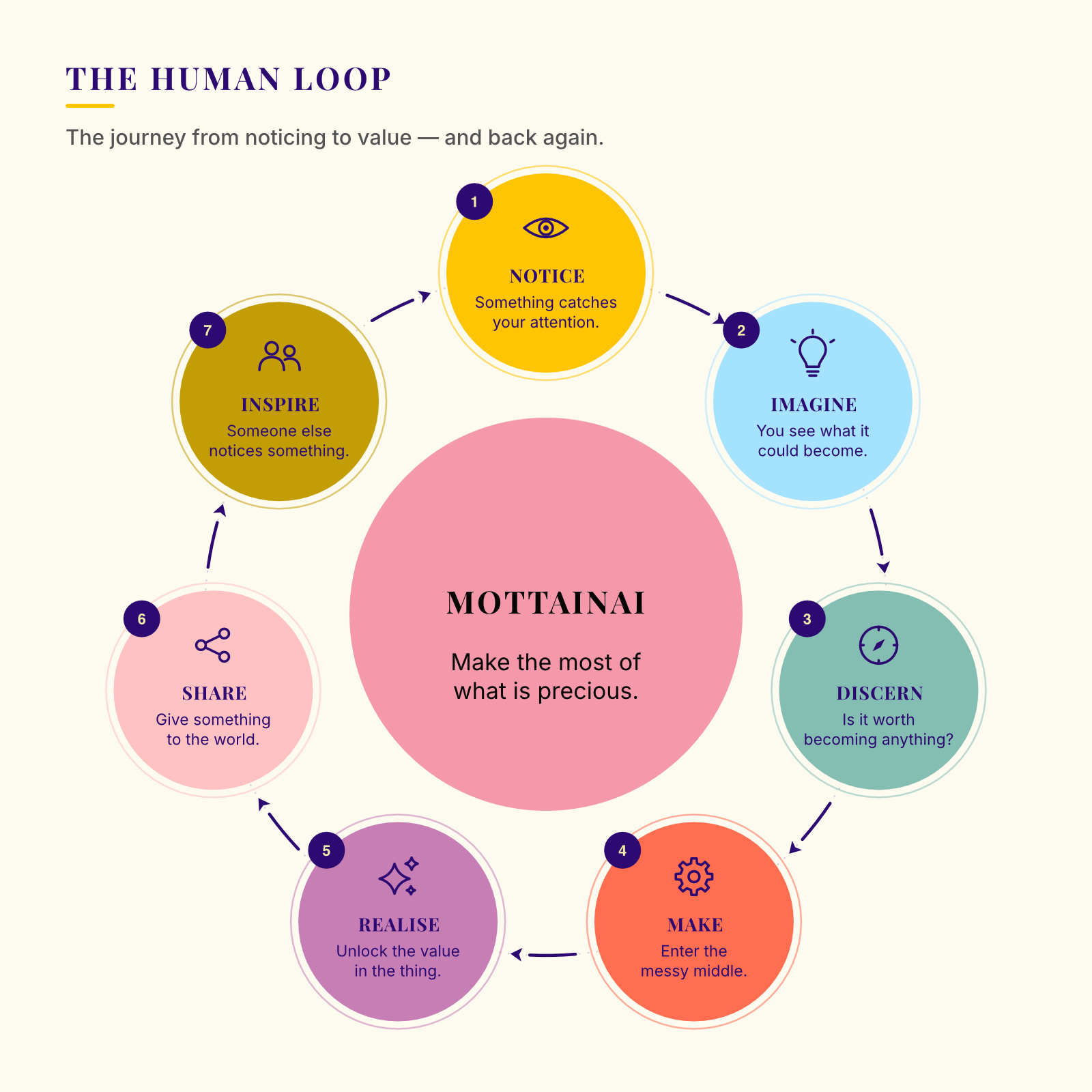
It happens in businesses, in careers, in creative work, and to a person at a desk with a notebook wondering what to make next.
It is, I think, one of the most interesting things humans do. We see things, we generate ideas, we risk being wrong, we make something, we share it, we aim for something valuable. And everything we do create has the potential to inspire others too.
The Idea to Value system
Idea to Value is the name I have given to how I look at that journey. It isn't a methodology or a delivery model. There's no certification. I'm not going to sell you a laminated version with a free tote bag, and give you five gold stars for using it.
If anything, it's the opposite of borrowed seeing, the habit of looking at your own work through somebody else's framework.
It asks you to look for yourself at what's actually happening between an idea and the value it could become.
It works for a person with a notebook, a creative business, a team, a department or a company of thousands. The scale changes. The human problem doesn't.
After enough years of looking, I noticed the same five places kept turning up. So I gave them names: the Map, the Physics, the Wiring, the Engine and the Flywheel.
Think of them less as stages and more as places to stand and look. Where are we? What's getting in the way? And why isn't this idea becoming the value it could?
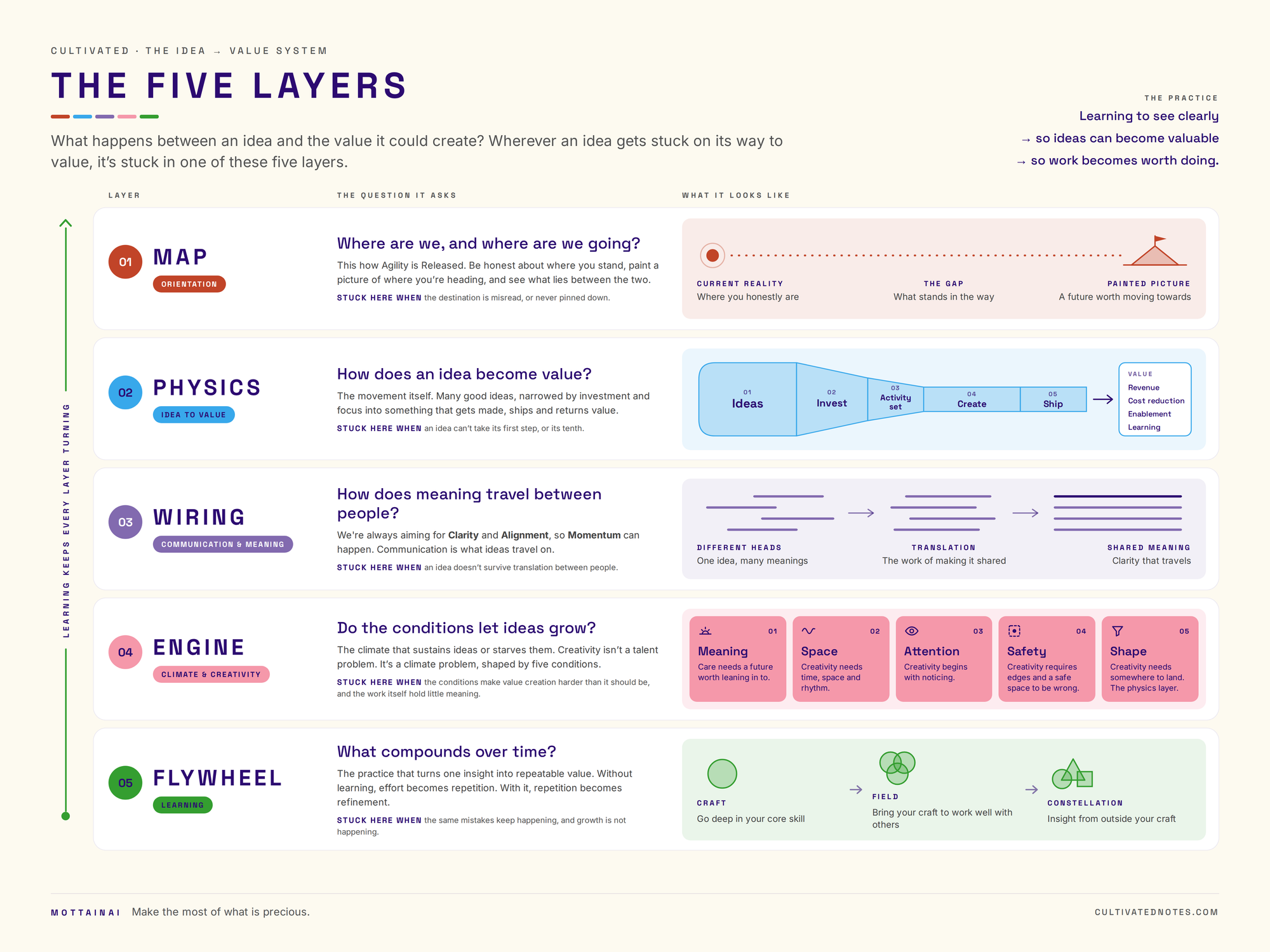
The Map
Where are we going, and is this idea worth taking there?
The Map is orientation. It holds the big picture: where we are now, where we're trying to get to, and why that future matters.
At its heart is a painted picture.
This is a rich, compelling story of the future that people can see themselves in and want to move towards. It's the reason the good days and the bad days are both worth it. For a company, that's purpose and strategy. For a team, it's what this year is actually for. For a solo creator, it might simply be why you're doing it at all.
It's worth then, asking a powerful question: if the future is that good, why aren't we there yet? The answer to which gives you your current reality.
The distance between is the work.
You see, without a Map for orientation, every idea looks promising. And a surprising amount of effort begins as a perfectly good idea heading in the wrong direction.
The Physics
How does an idea actually become something?
An idea appears. We noodle it. We ponder it. It joins the queue of a thousand other ideas we could do, and most of them, rightly, go no further.
The ones that do get invested in.
When we invest our commitment grows. The idea moves from something we could do to something we are doing. Then come the plans, the making, the shipping and, if we've got it right, value.
Idea → invest → activity set → create → ship → value.
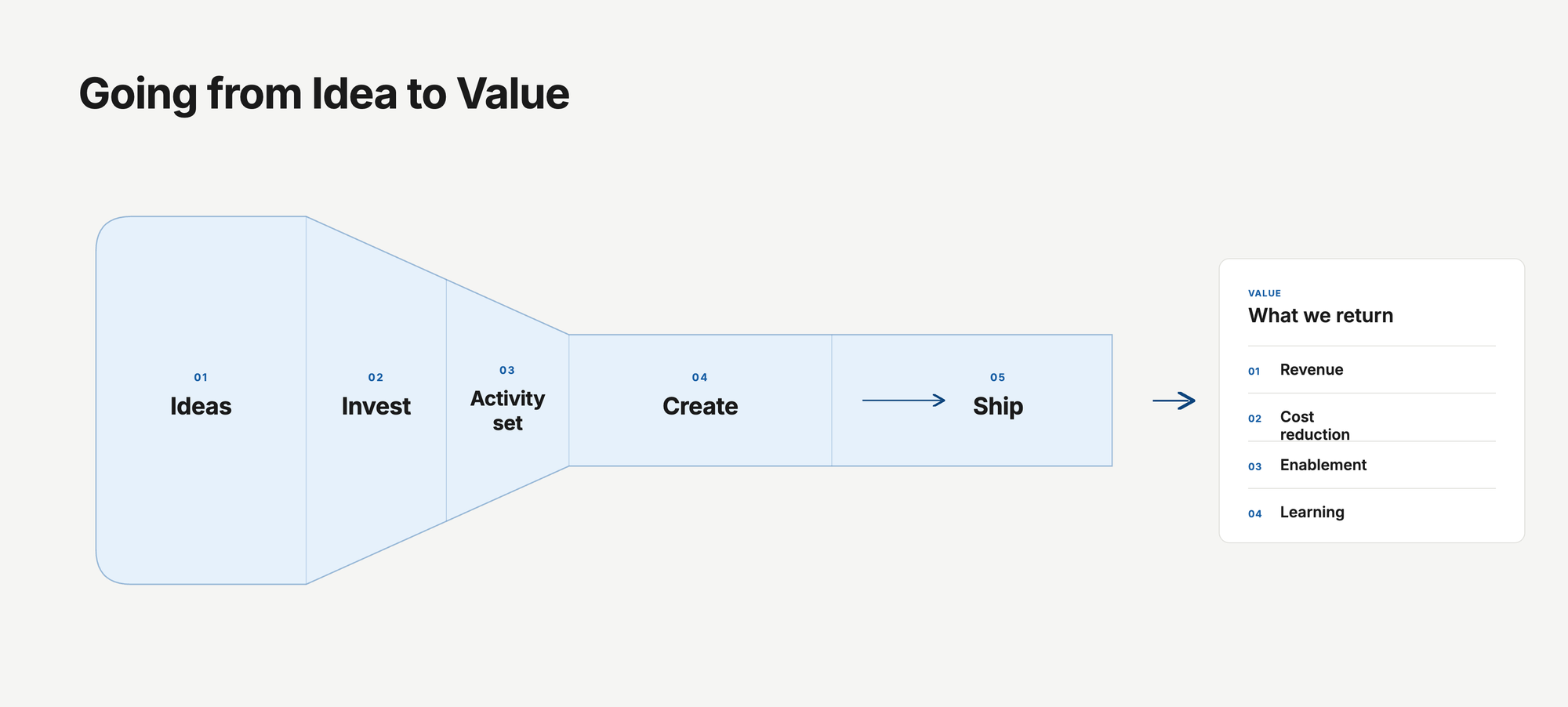
This is the physics of work: the mechanics of how an idea moves from someone's head into the world. Every step is an investment. Money, yes. But also people's time, energy and attention, the only resources nobody can make more of.
So a project that takes twelve months instead of four isn't just an efficiency problem. It's eight months of people's lives. Where did all that energy go? And was the idea still worth pursuing by month six?
The Wiring
Does the idea survive the journey between people?
Ideas don't stay in the head of the person who had them. They travel through conversations, artefacts, documents, presentations, meetings, products and decisions. Every handover is a chance for something useful to go missing.
Communication is the wiring. It carries meaning. Meaning creates clarity. Clarity makes alignment possible. And alignment is what lets people move together, rather than simply at the same time.
A presentation is an exchange. A workshop is a chance to make something. A meeting is a place where attention is either used well or wasted. A book is an idea travelling through paper and time. And a team making something together is, when you think about it, a small miracle of shared understanding.
This is where an idea lands, or doesn’t. You can have the best idea in the room, but if it doesn’t land in someone else’s mind, it often goes no further.
The Engine
Do the conditions let good work happen?
This might be the bit I care about most, because ideas don't make things. People do.
And people bring an extraordinary amount to work when the conditions allow it. Creativity, judgement, experience, curiosity, craft, care, a sense of fun, and the knack of noticing the thing nobody else has noticed yet.
Most organisations don't have an idea problem. They have a conditions problem. Put brilliant people in the wrong climate and you likely get painfully average work. Put ordinary people in the right one and they'll surprise everyone, including themselves.
Five conditions keep appearing:
Meaning. Something worth caring about. Care is the fuel.
Space. Time and room to think, explore and make.
Attention. Noticing what's actually happening.
Safety. Enough trust to be honest and to experiment.
Shape. Priorities, constraints and decisions that give good work somewhere to land.
They aren't boxes to tick. They're things to notice. A good climate isn't commanded. It's cultivated.
None of this is only for organisations. The same five conditions decide whether your own project gets made, whether you’re at the kitchen table on your own or in a team of fifty.
The Flywheel
Does the work make us better?
Whatever you make teaches you something, if you pay attention.
Learning is what keeps the whole thing turning. Your direction sharpens, your communication clears, your decisions improve and your craft deepens. It grows in three directions:
Craft. Going deeper into what you do.
Field. Understanding how your work connects with everyone else's.
Constellation. Following the odd, brilliant things from outside your work that quietly change how you see.
For an organisation, this is how capability compounds. For an individual, it’s how a career, or a body of work, gets more interesting. Without learning, effort becomes repetition. With it, repetition becomes refinement.
Value isn't only money
Ideas tend to create value in four ways. Some make money: something people want enough to pay for. That’s financial value, and it keeps a business, or a creative practice, going.
Some make things cheaper, simpler or easier to run. That’s cost reduction, and it frees up money, time, energy and effort for something better.
Some keep things able to run at all. That’s enablement value: the unglamorous work that keeps the lights on.
And some create learning: an experiment, an insight, a better understanding of the customer, the audience or the work. That’s the value that keeps you getting better.
It’s true for one person too. A talk that lands might earn you money, save you a year of explaining, open a door, or teach you what your audience actually cares about.
All four matter, and knowing which ones you're after changes the decisions you make. A team can become magnificently efficient at doing the wrong thing. An experiment can be hugely useful even when it doesn't produce the outcome you hoped for.
The point isn't to make everything produce money. It's to know what value you're trying to create.
What we're really investing
This is where it gets personal.
Organisations invest money. People invest life: time, energy and attention.
You can make more money. You can buy another notebook, start another project, change the plan.
But you cannot regenerate Tuesday afternoon. Or the attention someone spent in a meeting that ate the morning. Or the energy spent fixing the same problem for the fifth time. Or the years a talented person spent somewhere that didn't give them room to become what they could have become.
That's why the second question matters.
Not because work should be easy, or every project fun. Difficult things can be brilliant. The question is whether the investment gives something back. Did the people doing the work grow? Did the journey leave us with more than it took?
Don't waste what is precious
There's a Japanese word I keep coming back to: mottainai.
It's often translated as "what a waste", but it carries something more generous. It's an acknowledgement that things have worth, and a reluctance to let that worth go unrealised.
That’s how I think about ideas, and about the work of bringing them to life.
I'm less interested in hunting for what's broken than in what's already there. The person with an idea. The team that could do more. The knowledge nobody has written down. The customer insight sitting in someone's inbox. The skill someone hasn't had the chance to use yet. The little spark that could become a fire if somebody paid attention to it.
The question isn't only what's wrong. It's where the potential is, and what might happen if we gave it some room.
One system, any scale
The scale changes. The vocabulary changes. The questions stay surprisingly similar, whether you're one person with a notebook or a company of thousands.
Is this worth doing? How is the idea moving? Does it survive the journey between people? Can people do their best work? What are we learning? And perhaps most importantly: was it worth being part of?
So what?
There’s more possibility in our ideas than we tend to realise.
I know, because I've seen it. I've seen people make books when everyone expected code. I've seen teams find their way through problems that looked impossible, and people discover abilities they didn't know they had.
I've seen the opposite too. Good ideas disappearing. People becoming smaller versions of themselves. Time, energy and attention vanishing into the machinery of work.
I don't think either is inevitable. We can notice more. We can make more. We can waste less. And we can make the journey itself worth taking.
That's what Idea → Value is for. Not a framework to install, or another corporate initiative. It's a way of seeing, a habit of asking better questions, and a belief that the work of bringing an idea into the world can be useful to others and good for the people doing it.
More good ideas landing. More potential becoming useful.
And a little more life in the work while we're at it.
The Idea to Value system
The same body of work, shaped for different needs: the thinking behind it, the calm read, the guide you work from, and the guide for building your own. Take whichever fits where you are right now.
Idea to Value
The thinking underneath it all
Why any of this matters, and the twenty-year practice it grew out of — a working life spent paying attention to how ideas become value. Start here for the worldview beneath the work.
The Life of an Idea
Pocket-sized digital field guide
The whole system in its calmest form — all 26 ways to look at how an idea moves, in short chapters you read like essays, turning each one over clearly. The place to start if you want to see how ideas become value, and think about your own differently.
The Idea to Value Handbook
26 applied principles · free with Studio membership
The practitioner's handbook - a working version of the same system — all 26 principles with red flags to look out for, positive examples, things to observe, and the steps to take when an idea is stuck. The handbook you reach for on the job.
From idea to sustainable work
A 59-page guide for independents who want to build something durable from their own ideas.
The early work isn't you getting it wrong. It's the cost every idea pays before it pays you back. The skill is staying in the game long enough to come out the other side. For solo creators, independents and people working on their own spend. No hacks, funnel advice, or platitudes. The honest reality that everything before you start getting paid is an investment in potential, but it has a cost (money, time, energy and attention), and how, in the early days, the main value you receive is tuition.