How to Get Your Talk Accepted (Not Just Submitted)
Reviewers spend their evenings wading through submissions that read like a form got filled in because a form needed filling in. This is how to avoid being one of them.

Updated 24/09/2026
A wonderful side-effect of speaking at conferences is that, sooner or later, someone asks you to help run one.
Join the committee, they say. Shape the agenda. Build the programme.
It is a genuine privilege. You get to see a conference before anyone else does, because you helped shape it. You see the ideas that might make it onto the stage, the themes emerging from the submissions, the arguments that are going to run through the corridors and over the coffee.
It also comes with a considerably less glamorous job attached to it. Reading the submissions.
There's a spreadsheet, usually. A scoring mechanism. A stack – sometimes a hundred or more – of talk submissions from people who seem rather keen on taking a slot on the agenda.
And here's the thing they don't tell you when they invite you into the conference team. Hardly anyone tries with their submissions.
A title. A sentence or two. Some bullets. Perhaps a paragraph copied from their LinkedIn profile for good measure. Whatever effort has gone into the talk itself, almost none of it seems to have gone into the submission asking for permission to give it.
Which is strange, given what's at stake.
You can have the best talk on the programme. Rehearsed, ready, worth every minute of the audience's time, energy and attention. You can have spent three months making the slides, fine tuning the lovely fonts, sharpening the stories and working out exactly where the jokes go.
None of it matters if the talk never makes it onto the agenda.
Because a conference submission isn't a form, or a gate, or some administrative toll booth standing between you and the stage.
It's a piece of communication.
And its job, in this particular case, is to sell.
Not in the snake-oil sense. In the older, more useful sense: to make the case, honestly and well, for why this talk belongs on this stage, in front of this audience.
You want the person reading it to get to the end and think: We need this on the agenda.
That's a communication problem before it's anything else. So that's how it's worth treating it.
Why speak at conferences?
Before we get into the submission, though, let's get the thorny topic out of the way.
Why bother?
Speaking from a stage isn't really a performance. It's an exchange between someone with a good idea and people who have decided to give their time, energy and attention to hearing it.
A talk is also a form of publishing. It's one of the few places an idea gets to leave your notebook and become part of a public conversation properly: in a room, with people who came specifically to think about the thing you're saying.
That's why people speak. To share something they've learned. To offer a perspective. To start an argument, occasionally. To discover that someone else has been thinking about exactly the same thing.
It builds confidence. It opens doors into networks you didn't know existed. It puts your thinking in front of people who might otherwise never have found it.
It's also rather scary, which is character building in itself.
But underneath all of that, the value is simpler. Speaking makes thinking public. And that's the point at which an idea starts becoming the value it was always capable of creating.
It's not really about stage presence or speaking prowess. It's about making your thinking public.
Finding somewhere to speak
Assuming you're going to speak at one, you need to find a conference and get your idea onto its agenda. This sounds easier than it sometimes is.
Many conferences don't advertise themselves particularly well. I once heard about one happening here in Winchester only because a friend happened to be attending it.
There is no great central noticeboard for all the interesting conferences in the world, which is probably for the best. You find them in industry newsletters, inside communities you already belong to, mentioned by people you follow, recommended by someone who spoke there last year, or because somebody sends you a link with the useful words: “You should apply for this.”
What you're looking for is the Call for Papers, or CFP.
It's an invitation, usually issued months before the event. Treat it as exactly that: an invitation. Not a form to be rushed through. Not a test of your ability to copy and paste.
The conference will usually have a theme. It seems to be the rage. Themes give organisers and attendees something to hold onto – a shape for the day, so to speak. A thread that runs from one talk to the next, and then to the next, until a collection of individual talks becomes something resembling a whole.
You're not necessarily looking for a perfect match though. You're looking for a coherent fit: a plausible reason your idea belongs inside their story, rather than merely beside it, or not in it at all.
Larger events tend to split into tracks, with each one potentially housing its own sub-theme. Smaller events often have a single track and run more on editorial instinct. I tend to like these. The audience is smaller, but the conversation is often better.
If the whole thing sounds a little bewildering, don't worry. Find an angle into the theme. Experience tells me there's nearly always one.
What are you going to talk about?
Your ideas, of course.
This is the bit that stops many people before they've started. Most first-time speakers are convinced they have nothing worth saying. I hear this all the time.
They're wrong. Nobody else has your experience of your experience. Nobody else is you. And nobody else has exactly the same collection of things you've noticed, tried, failed at, misunderstood, changed your mind about and eventually worked out. That's more than enough to generate a good talk. And if you are still stuck, try this free chapter from Zero to Keynote about generating talk ideas.
A good place I recommend starting is with reports from your own work. The tools and practices you use. The mistakes you made and what they taught you. The things you tried that didn't work. The things you tried that did work. The frustrations you have with your industry.
Experience reports are particularly useful because they're honest, grounded and difficult to argue you out of. They happened to you. Although be prepared. Every conference has someone who argues with everything.
You're selling a place on the agenda
So here we are. A conference submission is a piece of communication and its job is to sell. What does that actually mean when you're staring at an empty submission form?
It means thinking about purpose, audience and context before you write a word.
Purpose
The purpose of your submission is not to deliver the talk. It isn't to explain every inch of the talk. It isn't to get a standing ovation, win a speaking award or receive a flattering LinkedIn message from someone you've never met. It isn't even to share your entire message.
The primary purpose is to get a yes.
You're selling a place on the agenda. But selling and informing aren't opposites. In fact, the best selling is often just good information presented clearly. You're not talking anyone into something they'll regret. You're not making something up. You're not using rhetorical wonder words to make an ordinary talk sound like the second coming of TED.
You're making the value of the talk easy to see. You're explaining what it is. You're explaining why it matters. You're explaining what the audience will get from it. You're making complex ideas understandable. You're using the simplest words and sentences you can. And you're doing all of this because you genuinely believe the talk deserves to be on that stage.
That's important.
If you don't believe it, why would anyone else?
Audience
But who are you writing for?
The reviewer.
You will very likely never know who is reviewing your submission. Reviewers are often anonymous and may not even work in your particular industry or field. So write as though you're explaining the idea to someone intelligent who doesn't know what you do. Because that may well be exactly what you're doing.
Simple beats clever here, every time. I sometimes run my submission through a reading-age check before sending it. Not because reviewers need it dumbed down. Because clarity is what gets something read properly. And communication, after all, is about creating understanding.
The reviewer should be able to read your submission and quickly answer four questions:
What is this?
Why should I care?
Why will the audience care?
Why are you the person to give it?
If they have to work those out for themselves, you've made them do some of your job for you.
And they have seventy-nine other submissions to read.
Context
This is the one people almost never consider. And it might be the one that matters most.
Imagine the person reading your submission.
It probably isn't a sunlit editorial office with a large wooden desk and a cup of excellent coffee, quietly contemplating your carefully constructed prose. It might be Tuesday night. Or Sunday afternoon. Or a lunch break.
There's a spreadsheet open. They've already read 77 submissions. They have another 23 to go. Someone has submitted a talk called Unlocking the Future of Synergistic Transformation and they are beginning to question how they should express their rage. And whether they've made the right life choices too.
They're tired. They're probably doing this in their own time. And they're about to read yours. You don't need to entertain them. You need to make their job easy.
That's context.
It costs you very little extra effort to take it into account. A little more clarity. A little more care. A little less jargon. A little more respect for the person on the other side of the form.
It can be the difference between being read properly and being skimmed. It can be the difference between a yes, and the reviewer raging down the street kicking over wheelie bins.
Know what you're selling
Before you sell the talk, know what you're selling.
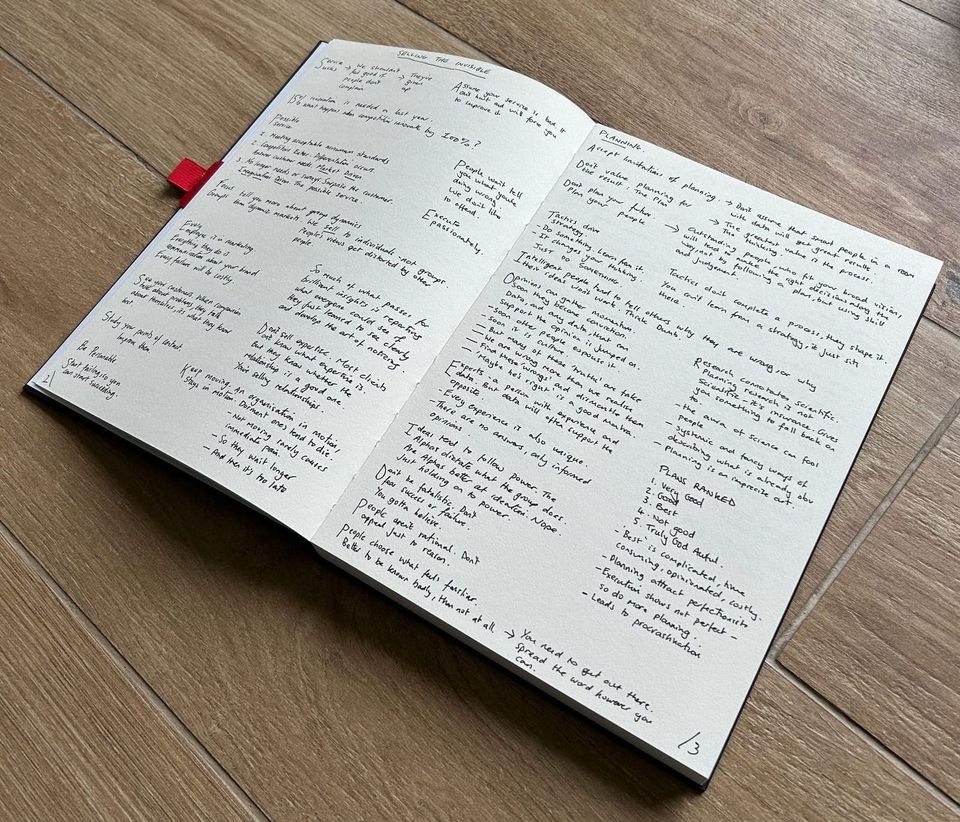
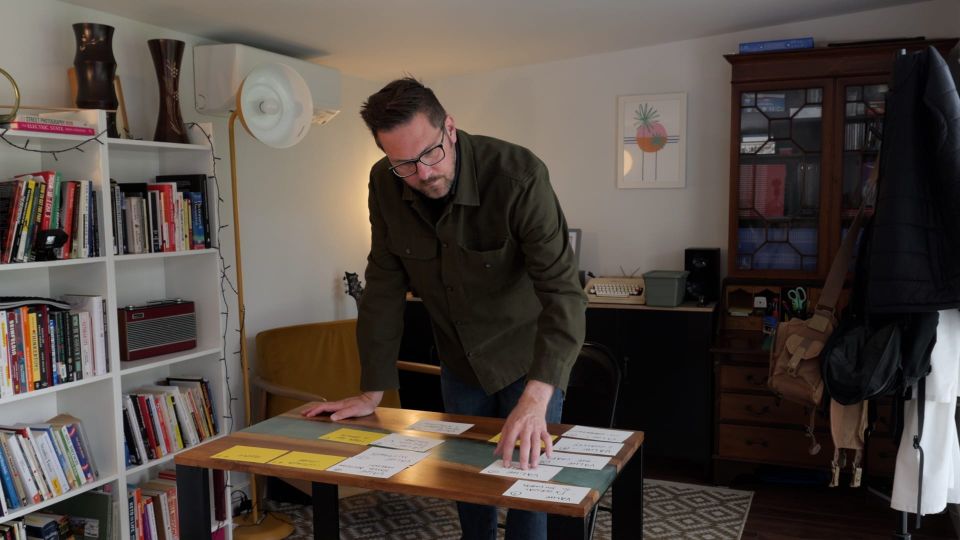
You don't need the finished talk. But you do need to know what the talk is. Outline it. Use index cards, a mind map, a notebook, the back of an envelope – whatever gets the idea in your head into some visible shape.
You're not writing the talk yet. You're finding its order.
Somewhere in that outline there should be a problem. Every good talk has one. It might be a problem to solve or an opportunity to open. They're the same coin viewed from different sides.
I'm doing good work but nobody seems to notice is a problem. How to Make Your Work Visible Without Becoming a Self-Promoting Arse is a talk.
The problem gives the talk somewhere to go. Name it clearly and the rest tends to organise itself. You can leave some of the middle vague, deliberately. The who-said-what and the seventh example belong in the talk itself, later, once you've got the yes.
What you do need are some clear takeaways.
Three or four answers to the question:
What does somebody know, see or understand differently when they leave the room?
Those are the outcomes. And they will do more work for you than a dozen polished adjectives and a wonderful sense of optimism.
Make it easy to say yes
Now write the submission. Then simplify it. Then simplify it again. Then again. We have a very human tendency to write lots of words.
Cut anything that doesn't earn its place. Stay inside the word count on purpose, rather than because you ran out of real estate.
There's a person we all know who irons everything, including the T-shirt underneath the jumper and their socks. Write your submission as though that person is reading it. Not because you need to impress them. Because you need to make it easy for them to understand what you're offering and not find fault with your submission.
Don't confuse the submission form with the writing, either. The form is just the delivery mechanism. Write somewhere you control first. A document you can leave open, rearrange, cut, return to and occasionally stare at with bewilderment and disappointment. Not a form that will happily time out mid-way through your submission.
Read the CFP properly. Then read it again. Maybe one more time for good measure.
I've read submissions missing key pieces of information because the person hadn't quite read the brief. I've also seen submission of 1,000 words when the organiser actually asked for 1,000 characters.
These things matter. A submission missing half the brief tells the reviewer something before they've read a word about your idea. It says you weren't paying attention. And if you weren't paying attention to the person deciding whether to put you on stage, what might you be like with the audience?
Note the deadline. Work backwards from it. Give yourself enough time to write the thing, leave it overnight and come back to it with fresh eyes. Distance is a remarkably good editor. What looked elegant at 11.47pm often looks rather less so at 8.15am.
Then send it. And keep a copy. You'd be surprised how useful your old submissions become – especially when you get accepted and can't remember what you said you'd speak about.
Give them a reason to want it
Of course, none of this replaces having something worth saying in the first place. But having something worth saying is not necessarily what keeps a talk off the agenda. A poorly communicated submission can do that perfectly well.
The submission is your first opportunity to turn the idea into something another person can see. You're not trying to trick the organiser. You're not trying to game the scoring system. You're trying to make the value of the idea so clear that they can make a good decision about it.
That's what selling is supposed to do.
And when I'm reading the stack of submissions, it's rarely the most seasoned speaker who stands out. It's whoever remembered that somebody tired, over-caffeinated, disappointed by the lack of effort and on entry number seventy-eight is about to read this — and had the rather good manners to make it easy for them.
That's communication. And that's how you get onto the agenda.
For the deeper, end-to-end journey from idea through to walking off stage, the full guidance lives in Zero to Keynote.
For those who like a list — The Conference Proposal Process
CommunicationTen steps to a winning conference proposal
Conference proposals reward clarity over cleverness. Follow the sequence, then simplify.
Read the CFP carefully
Note deadlines, formats, and required assets. Submissions that ignore the brief signal carelessness.
Create a submission checklist
Bio, headshot, abstract, key takeaways — prepare them once, reuse on every submission.
Define Purpose, Audience, Context
Purpose: To sell. Audience: conference reviewers. Context: What state the reviewer is likely in — respect their attention.
Outline the talk
Focus on a single core messagem, usually a problem/opportunity. Structure follows clarity — not the other way around.
Write the problem statement
What problem does this talk solve for the audience? If you cannot answer this in one sentence, the proposal is not ready.
Sketch the middle
High-level flow only at this stage. Slides and detail come later — the proposal needs structure, not production.
Define key takeaways
Conferences typically request three or four. Be specific."
Simplify
Remove everything that does not serve the core message. One idea, clearly expressed, beats three ideas vaguely pointed at.
Pause and revisit
Distance reveals clarity. Leave it overnight. Read it as a reviewer, not as the author.
Submit and archive
Save every submission. Build a personal talk library. Each submission makes the next one faster and sharper.
The Video
This essay continues on film: the same idea, with more room to show it.
Free download with Meeting Notes
The Conference Speaker Checklist
A practical companion to this guide — the full proposal process on a single printable sheet, along with everything else to check to help your ideas land with the audience. Keep it at your desk. Free when you subscribe to Meeting Notes newsletter.
Free to subscribe. Unsubscribe any time.
Where this sits in the Atlas
Orientation·Idea to Value·Communication·Creativity & Climate·Learning