Before there were feeds, there were lists
On making A List of Good Things, a free printed catalogue inspired by Victorian circulars, and why a recommendation that costs something means more.

On a bright, cold Friday afternoon, I was crouched in an aisle of P&G Wells in Winchester, camera in one hand, headphones half on, waiting for a gentleman to finish browsing so I could get my shot.
P&G Wells is possibly Britain's oldest bookshop and certainly Winchester's oldest. Its history dates back to 1729. That's almost 300 years of people walking through the door in search of something interesting. When the Victorians were wandering around Winchester in the 1870s, the shop was already nearly 150 years old. It's quite a thought.
I was doing my best not to damage any of that history while setting up a decent camera angle. At the front of the shop, near the counters, sat an A4 printed sheet I'd made called A List of Good Things. I'd come in to make a short film about it.
Which sounds straightforward until you actually try it.
Is the light right? Is that a hum in my headphones, or just the building, or is it the gentleman browsing historical biographies? Is the List in focus, or the book behind it? And can I get any of this done without becoming the man who ruined someone's quiet Friday afternoon in a bookshop?
Filming is a funny business. You start with a perfectly good idea, point a camera at it, and discover hundreds of things you hadn't thought about. More importantly, you discover that what you intended to show and what someone else actually sees are two rather different things.
I knew why I'd made the List. I knew what I thought about it. But a camera only records what's in front of the lens, and that's all the viewer gets to see. Every shot became a little decision: does this show what I mean, or just what's there?
The team at P&G Wells were wonderfully accommodating. After much discussion about why we need more analogue projects in the world, they kindly took me through to their bookbinding room, tucked away among the old brick rooms at the back.
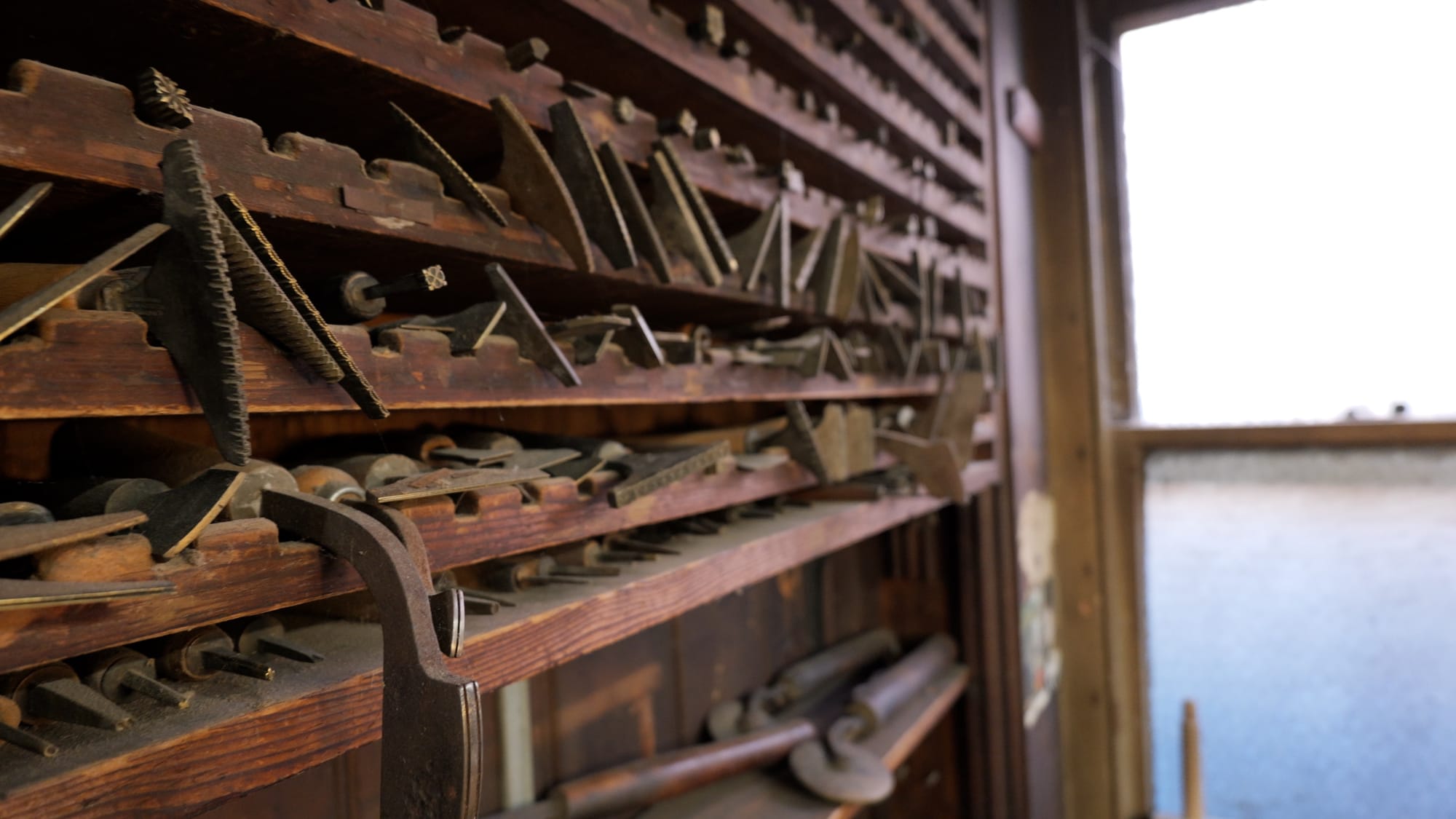
It was spectacular.
Books, tools, old materials and the evidence of people making things by hand for a very long time. There's something rather reassuring about a room like that. Everything has a purpose, everything has a place, and someone has spent a considerable amount of time getting good at doing something.
I left a stack of Lists for their customers and walked on to the next location, very chuffed with myself that something I'd made at my desk was now sitting on the counter of a bookshop that has been passing good things across it for generations.

The Video
This essay continues on film: the same idea, with more room to show it.
Before the feeds
Before the feeds, the algorithms and the endless recommendation engines, people had lists.
Booksellers, publishers, merchants and all sorts of businesses chose things they thought were worth knowing about and printed them for anyone who'd take one.
The Victorian circular was a single sheet with one job: to tell you what had arrived and why it might deserve your attention. It was folded into parcels, left on counters and passed from hand to hand until it wore through at the creases.
Second-hand booksellers did the same with considerably more obsession. Numbered lots, a line of description, the occasional dry remark about a cracked spine. Densely informational in exactly the right way. Seed merchants and ironmongers printed catalogues thick enough to prop a door open, and people kept them for years.
And in the 1980s, when I was growing up, we always had a Betterware catalogue, an Auto Trader and countless mail-order catalogues lying around. You could spend a wonderful afternoon discovering things you didn't know you needed, most of which you probably didn't – especially the stuff in the Betterware catalogue.
Curated lists were everywhere.
Every one of them was somebody saying: I've found some interesting things, and I think you might like them too.
That's the part I wanted to keep.
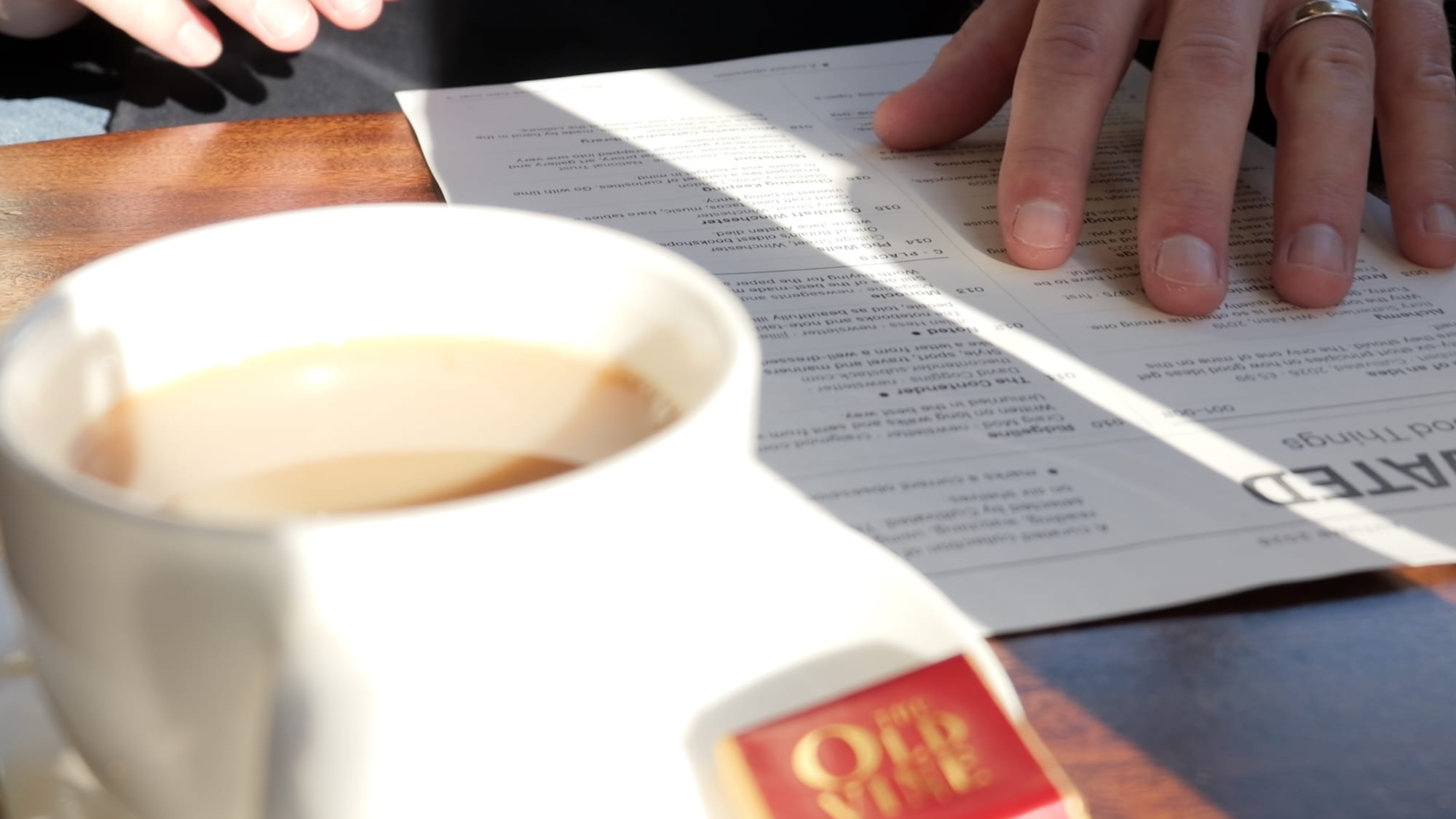
A feed makes recommendations feel effortless. A printed list makes the effort visible. Somebody has to choose the things, write about them, design the page, fiddle with the margins, choose the font, find the right paper, get the ink on it and, eventually, walk into town with a stack under their arm.
But, there's an important difference between the two.
Rory Sutherland often talks about the value of costly signals: the idea that when somebody invests time, money or effort in communicating something, that investment itself can make the message more credible. We tend to take notice when somebody has gone to a little trouble.
A printed list is a tiny example of this. It says somebody cared enough to make it.
And perhaps that's what I miss about some of the older ways of sharing things. Not the inconvenience, necessarily, but the evidence of human involvement. Someone has been looking, choosing, thinking and putting things together. You can feel it. You can see it. You can sense it.
How the List is made
So I made a curated list. Thirty-five things that are interesting, curious and, I think, worth knowing about.
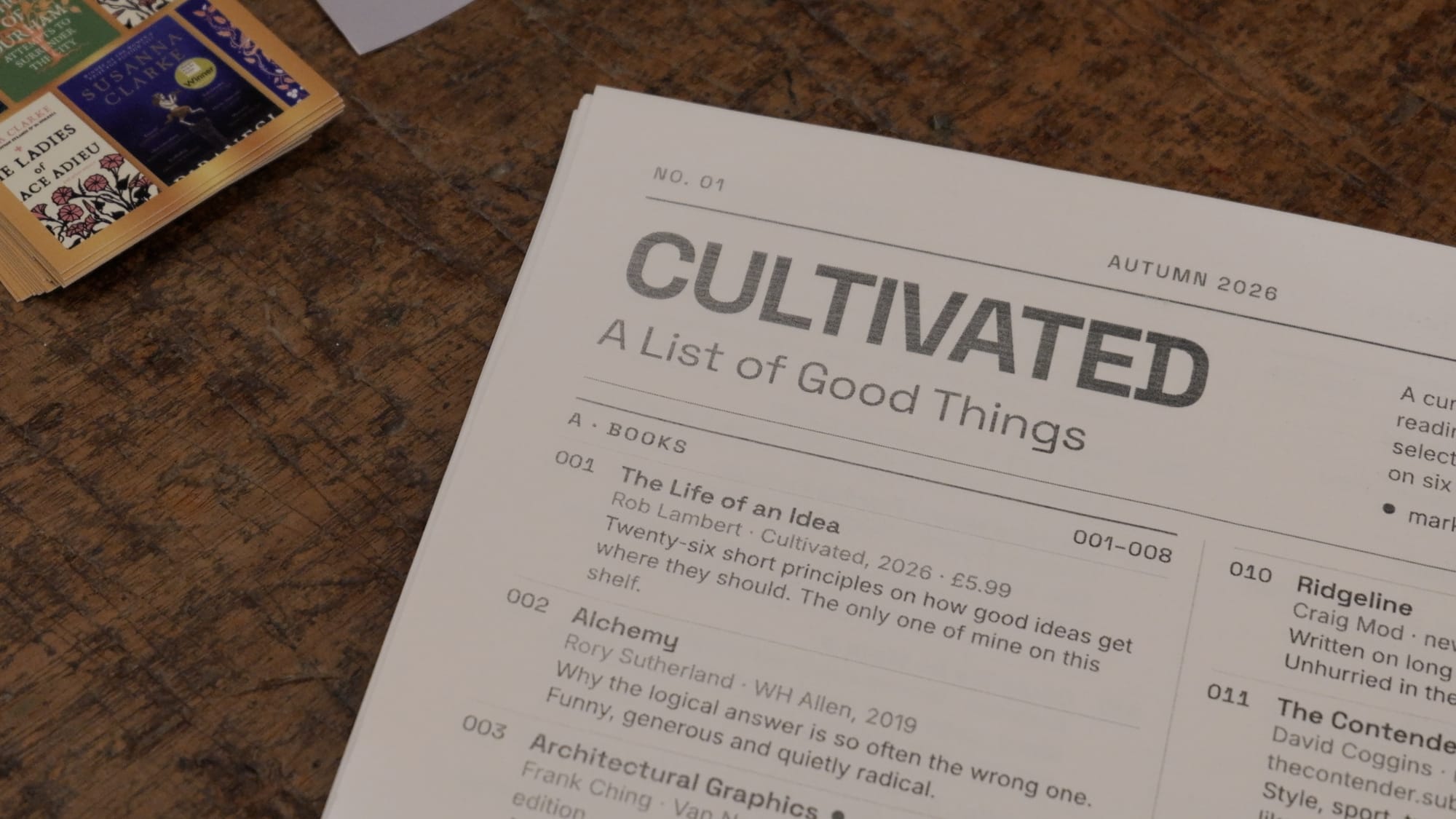
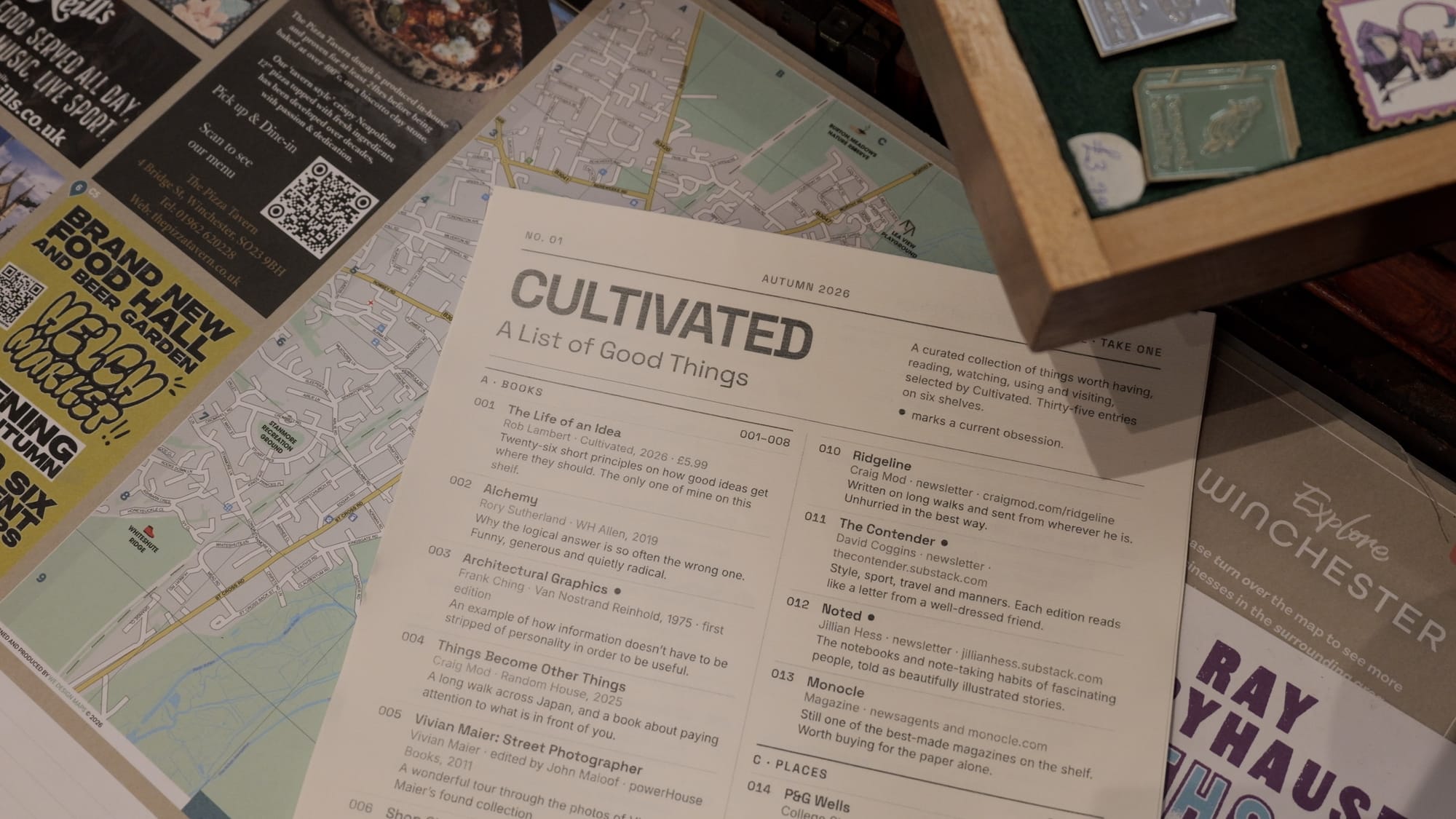
It borrows the mechanics of those old catalogues. Two sides of A4, black ink on ivory paper. No photographs, no gloss. Numbered entries, a line or two on each, set in Space Grotesk and Inter, with small rules and plenty of restraint. Dense lists.
The selection does a lot of the talking. I hope.
The entries sit on six shelves rather than in categories: Books, Things to read, Places, Paper & Things, Watch & Listen, and Other Good Things.
A shelf is a little looser than a category. It gives my rather broad interests somewhere to land. It's also how things end up next to each other in a real house, which is how a 1975 architectural drawing manual comes to share a page with Tom Hardy's rap album. I'm not sure either would have requested the company, but I think they get along.
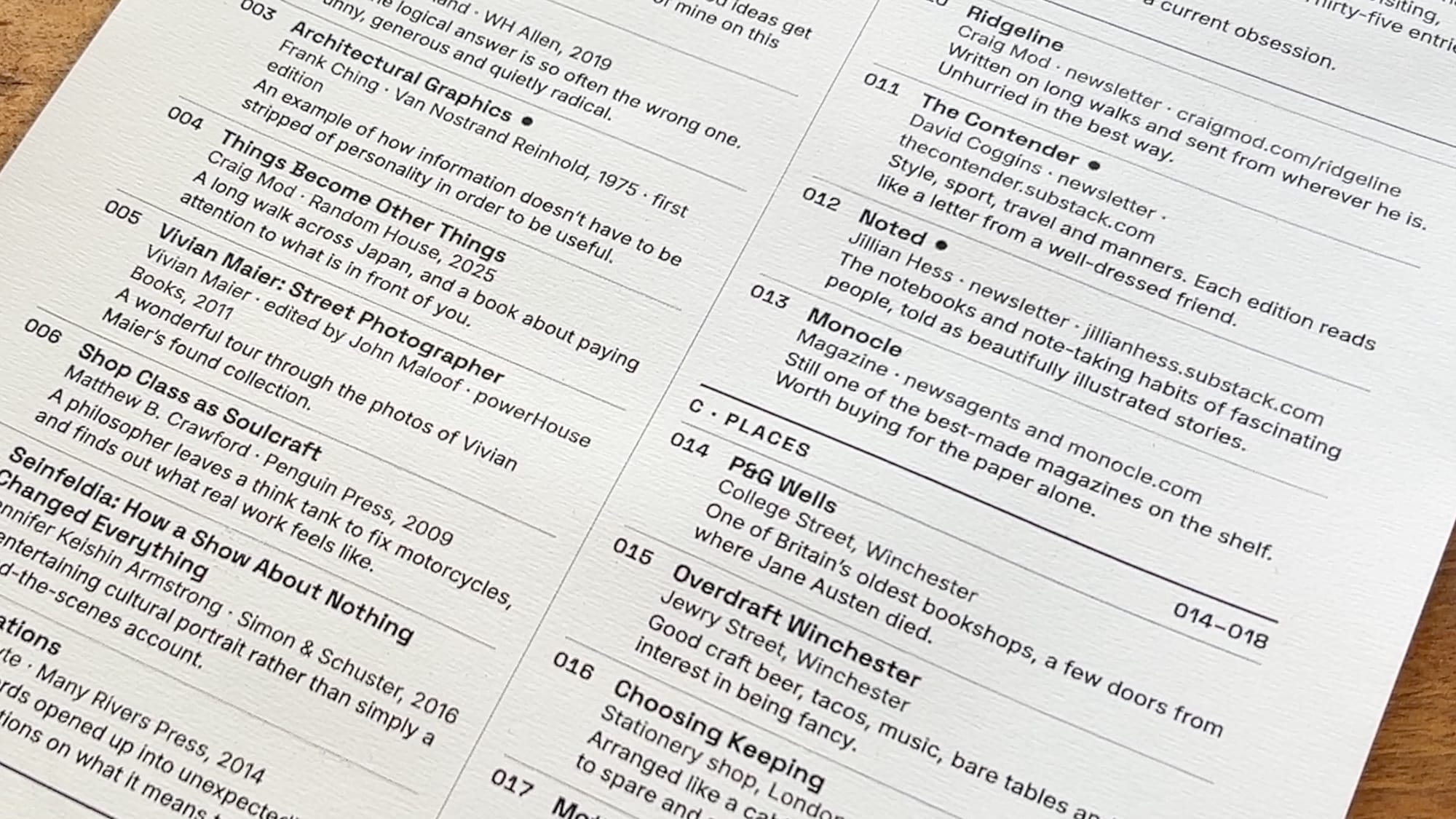
A few rules helped make the List what it is. After all, constraints force creativity.
Only one of my own books will ever appear on the List. Nobody pays to be included, so every item is there for the right reasons. A small dot marks a current obsession, and there are six of those in the Autumn Edition No. 01.
Entry 003 has one: Frank Ching's Architectural Graphics, a drawing manual lettered entirely by hand. It's one of the best examples I know of useful information that hasn't had all its personality stripped away.
Further along you'll find Mottisfont, the Sailor Fude de Mannen pen I now reach for whenever a thought needs catching, and, at 035, postcards. Buy one, write three lines, post it the same day. It's wonderfully old school and, as a way of communicating with another human being, remarkably effective.
One shot
The same weekend I shot the film, I watched Athena, Romain Gavras's French film. It opens with one extraordinary unbroken shot through crowds, noise and chaos. Having spent an afternoon struggling to film a single sheet of paper without annoying anyone, I watched it with my mouth slightly open.
I wondered how they'd made it. Thankfully, Netflix also had the documentary of how they made it too. So I watched that as well. The technical side was extraordinary, but what stayed with me was something more human.
A film like that starts as an idea in someone's head. To reach anyone else, it has to become something people can see. And the form it takes shapes what it means. One unbroken shot puts you in the middle of the action. You can't look away because the film won't let you.
The List works on a much smaller scale, but it's a similar problem. I could have posted thirty-five recommendations on Instagram and they'd have been scrolled past by teatime. Printed, numbered and left on a counter, those same thirty-five things become an object. Someone has to pick it up. It can be folded into a coat pocket, pinned to a noticeboard or handed to a friend.
The form carries part of the message.
And that's an interesting thing to think about. We spend an awful lot of time deciding what we want to communicate, and rather less time thinking about the form that will help it reach someone. We send an email when perhaps we should have a conversation. We create a presentation when perhaps we should make something people can hold. We publish another post when perhaps we should send somebody a postcard.
Not everything should be an email. In fact, very few things should be.
That, more or less, is what I spend my time thinking about: noticing what's worth noticing, and giving it a form that lets its value reach someone else.
Pointing things out
I kind of like the idea that someone might pick one of these up in a bookshop, discover something they didn't know existed and have a slightly better afternoon because of it.
There are so many interesting things in the world. Books, places, people, objects, ideas, little discoveries, often hiding in plain sight. Sometimes all it takes is someone pointing them out.
You can get a digital copy of No. 01 here, print it at home, or pick up a physical copy at P&G Wells or Overdraft Bar in Winchester. And who knows, perhaps somewhere near you too. I drop them in the post to interesting people, include them when someone buys a printed book, and leave them in all sorts of places (with permission, I might add).
If you run a bookshop, café, museum, office that likes a little curiosity or stationery shop and would like a few, get in touch.
And if you fancy it, make your own.
Five things worth knowing about, written on a single sheet and handed to someone who might like them. It'll cost you a little time and a bit of paper.
That's rather the point.
Where this sits in the Atlas
Orientation·Idea to Value·Communication·Creativity & Climate·Learning