A man called Obvious
One of the most useful business books I know is about eighty pages long, was first published in 1916, and spends a remarkable amount of writing on tinned peaches. On Obvious Adams, learning to see, and five tests for the obvious.
A slim book from 1916, a great deal of tinned peaches, and five tests for spotting obvious solutions — the improvements already in plain sight, once you learn to see them.
One of the most useful business books I know is about eighty pages long, was first published as a short story in 1916, and spends a surprising amount of its writing on tinned peaches. And it's a joy.
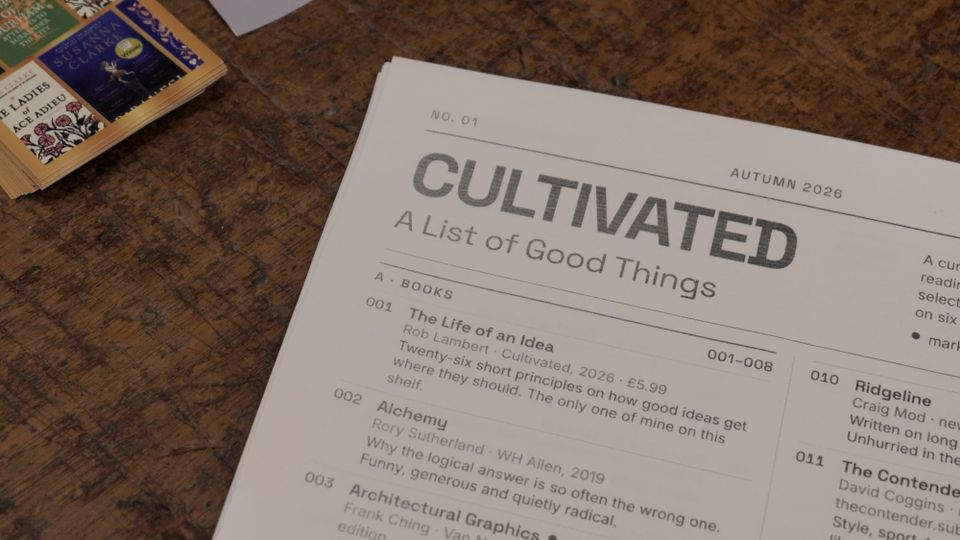
It's called Obvious Adams, by Robert R. Updegraff. This summer it was reissued with a foreword by Rory Sutherland, which feels rather appropriate since I bought it after he recommended it a few years back. If anyone has built a career on noticing what everyone else walked straight past, it's Mr Sutherland.
The hero is Oliver B. Adams, a young man from a small New England town. He works in a grocery store, studies at night school, and one evening hears a talk by James B. Oswald, who runs an advertising agency. The next morning Adams asks his boss for two hours off, goes to the agency and waits until Oswald will see him.
Oswald turns him down. Then, on reflection, he gives him a job checking and filing periodicals – which, as starts in advertising go, is roughly the equivalent of being handed the stapler and told to sit in the basement.
What follows is a series of small, devastatingly obvious moments of common sense. The copy department is working late on a campaign for a peach canners' association, so Adams goes off, learns about peaches, and writes an advert nobody asked him for. It's good. So good, he's made an apprentice copywriter.
Later, a cake company's campaign doesn't sell and the client walks away. Adams goes back to the problem, and what emerges is almost embarrassingly plain: the company had done plenty of advertising and not much selling. He suggests a change to the packaging. Sales go up.
Twenty-five years on, he's running the place.
That's more or less it. No twist, no framework with a memorable acronym, no certification, no borrowed seeing. Just a man who looks at what's in front of him, says what he sees, and keeps turning out to be right.
I am not Obvious Adams
I'd love to tell you I'm an Obvious Adams. I'm not but I do spend a lot of time looking, watching and noticing.
Many in our workplaces are the opposite of Obvious Adams. Hand them a simple problem and they'll build a small cathedral around it, with a vestry, three side buildings and a governance model with oversight on top of the oversight.
It's a very human thing to do, and especially tempting if you're clever. Most people I work with are very clever indeed. However, cleverness loves a detour. The obvious answer feels a little thin, a little beneath us, so we add a layer. Then a framework to hold the layer. Then a tool to manage the framework, and a meeting to talk about the tool. And then another framework to hold the collection of tools, layers, meetings and tools. It's this human cleverness that assumes an elaborate solution is the most appropriate, intelligent and suitable. It rarely is.
Updegraff saw this coming more than a century ago. "The obvious," he wrote, "is so simple and commonplace that it has no appeal to the imagination."
The obvious answer doesn't get rejected because it's wrong. It gets rejected because it's boringly simple and obvious.
Hidden in plain sight
The obvious isn't hidden. It's camouflaged by familiarity.
Spend a few months anywhere and the odd thing becomes the normal thing, and then the normal thing becomes invisible. The report nobody reads. The handover that happens in a corridor. The form that asks for the same information three times. You stop seeing them in roughly the way you stop hearing your fridge, or your kids.
It's the same reason I carry a camera in London. The moment it's out of my pocket, I start seeing things I've walked past a hundred times.
A rather embarrassing amount of what clients pay me for is saying the obvious out loud. That's not because I'm cleverer than the people in the room, often far from it. They know their work far better than I ever will. It's because I haven't got used to it yet, so I can still see it clearly.
What Adams has is a habit, not a talent. He goes and looks. He learns about peaches before he writes about peaches. He notices. He studies. He watches. He asks questions. He empties his mind of pre-defined answers.
It's the opposite of what I call borrowed seeing, which means installing somebody else's framework or way of seeing, instead of studying what's actually in front of you. The Idea to Value system I work with is really a structured way of doing what Adams does – seeing.
You look at what sits between an idea and the value it could create, and you notice what's obviously in the way.
Most of the improvements worth making are already in plain sight. The work is learning to see them.
Five tests for the obvious
In a later edition, Updegraff added five tests for spotting an obvious solution. I've paraphrased them here, with a few notes of my own.
One: it feels simple.
When you land on the right answer, it often feels slightly embarrassing, as if you should have seen it on the first day. If the answer needs a diagram with a legend, it probably isn't the obvious one yet. Keep going.
Two: it fits human nature.
Updegraff's test is whether you could comfortably explain it to your family, your neighbours or your barber. I'd add anyone at the dinner table, who will tell you quickly if it's daft. If an idea needs a long run-up before people understand it, they'll struggle to act on it. If it needs a degree to understand it, it is too complicated.
Three: it survives paper.
Write it out in a few short paragraphs of plain words. Draw it. Put it on an index card. Complexity has nowhere to hide on a small piece of paper.
In my Problems from a Vending Machine workshop, people squeeze a problem and its solution into a tiny physical object. It's lovely to watch. The clever-but-convoluted ideas simply don't fit, and the obvious ones drop out of the bottom like a packet of crisps.
Four: it gets a "why didn't we think of that?"
Updegraff describes the reaction as explosive. In my experience it's more equine in nature: a pause, a laugh, and someone saying "well, yes" in a slightly put-out voice. That small grumble is one of the best sounds in work. It means the idea will travel, because people can carry and communicate it to the next room without a slide deck.
Five: the time is right.
Even the obvious has a season. Sometimes the idea is right and the moment isn't. That's no reason to drop it, only a reason to keep it somewhere you'll find it again.
Obvious is not the same as easy
Obvious doesn't mean trivial. It means practical, understandable and doable. People can grasp it, agree on it and get on with it.
The best solutions often look simple for a reason: someone did the thinking, the pruning and the leaving-out. They haven't confused people by trying to define everything. Simple answers move. Complicated ones mostly need carrying, dissecting, a fifty-page playbook, a glossary and a team to help people understand them.
So the next time something at work looks hopelessly tangled and confusing, it might be worth doing what Adams does. Go and look. Learn about the peaches. Write it down in the simplest form of words. Explain it to someone at the dinner table or your kids. And if somebody says "why didn't we think of that?", try not to look too pleased.
It usually isn't hidden. It's just obvious – and seeing the obvious, it turns out, takes a little practice.
Where this sits in the Atlas
Orientation·Idea to Value·Communication·Creativity & Climate·Learning
Further reading
Obvious Adams
Robert R. Updegraff's short book from 1916 on the power of the obvious in business. As recommended by Rory Sutherland. You can read it in an evening, and it's worth rereading every year.
View on Amazon →