In praise of the amateur
We often use amateur as an insult at work. But the word comes from the Latin for lover — and Vivian Maier's story shows exactly why that matters.

The word amateur began in love. Somewhere along the way we turned it into an insult – and forgot the better half of its meaning.
Someone called me an amateur the other week.
They meant it unkindly. The implication was that I didn't quite know what I was doing – that my efforts weren't up to scratch, that I was falling short of the professional they'd decided I ought to be.
And I'll admit I was rather pleased.
Not because I enjoy being insulted; I'm British, so I can absorb a little disapproval without making a scene, but I wouldn't take it up as a life-time hobby if I could avoid it. I was pleased because amateur, once you know where it comes from, is one of the nicest things a person can be accused of.
The Video
This essay continues on film: the same idea, with more room to show it.
A word about love
It arrives in English from the French amateur, and before that the Latin amator – a lover – sharing its root with amare, to love.
An amateur, in the original sense, is simply someone who does a thing for the love of it. Not for money. Not for recognition. Not because it will look well on a CV or move a career along an inch. Only because the thing itself draws them in.
We still use it this way when we're not thinking too hard.
The amateur astronomer out on a cold lawn at midnight annoying the neighbours. The amateur musician who plays for forty years and never once expected a record deal. The amateur photographer who carries a camera everywhere and keeps noticing the things the rest of us walk straight past. That's me.
But the word leads a double life. Call someone an amateur at work and you're not handing them a compliment – you mean they're clumsy, unskilled, bundling, making a bit of a hash of it.
One meaning is about love. The other is about not being much good. And we've become rather expert, as a culture, at remembering the second and forgetting the first.
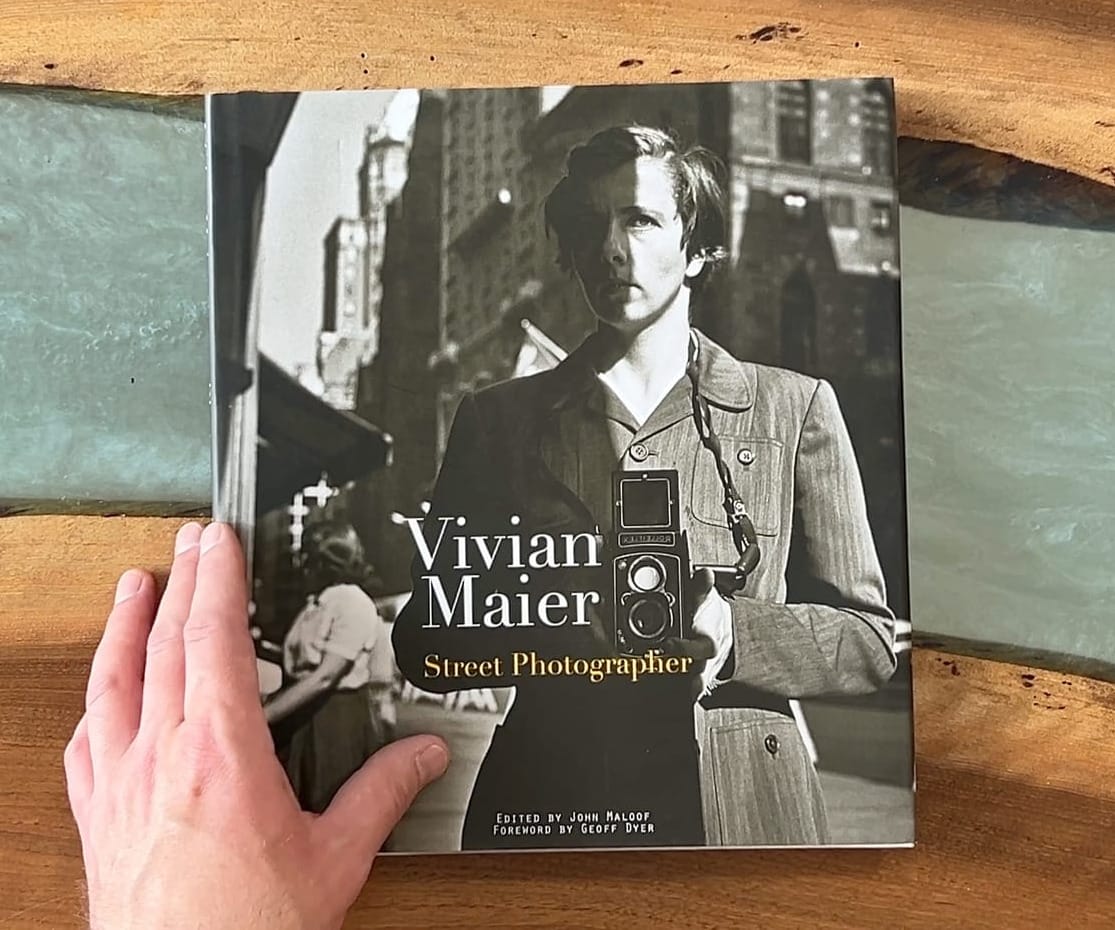
I was pondering this distinction the other evening, leafing through one of my favourite photography books.
The nanny with thousands of photographs
The book in question is a little gem. It's a book of Vivian Maier's street photography – ordinary mid-twentieth-century American life caught with a remarkable eye.
Maier earned her living as a nanny, much of it in Chicago, looking after other people's children. And in the margins of that life, she photographed. Relentlessly. By the end there were somewhere in the order of a hundred thousand negatives, perhaps half as many again – a great many of them never developed, never printed, never seen by a single person while she was alive.
Isn't that interesting?
She died in 2009. Her work had already begun its slow escape from storage: a young collector, John Maloof, had picked up a box of her negatives at a Chicago auction a couple of years earlier, with no real idea what he'd stumbled into. As he and others pieced the archive together, an astonishing body of photography came into the light. Today her work hangs in galleries around the world, and the documentary about her, Finding Vivian Maier, was nominated for an Academy Award.
What stops me every time is the gap.
Here was a woman who spent decades photographing streets and faces and shop windows and reflections and the unrepeatable moments everyone else missed – building a way of seeing all her own – and the world had no idea she was doing it.
We can only guess what the camera meant to her, or whether she ever imagined an audience. But a hundred thousand frames unpublished is not the output of someone chasing applause or someone with a mild interesting in snapping a few shots of the family. It's the output of someone in love with the looking.
She just kept going.
And that's the part that's deeply interesting. The work existed before the recognition. The eye before the exhibitions. The photographs were made long before anyone was waiting to see them – and whatever the world eventually decided they were worth, she'd already had the decades of making them. There's something rather wonderful in that.
The trouble with being a beginner
At work, we tend to reach for "amateur" to describe someone still finding their feet.
They try something new, fumble it, haven't yet got the hang of it – and the word lands on them like a verdict on the person rather than a fair description of where they happen to be in the process of learning.
We've developed an odd expectation that people ought to arrive already knowing. We want the confidence before the experience, the competence before the practice, the results before anyone's had the chance to work out how results are produced. Which is a rather weird thing to ask, because every expert was once an amateur. Every assured craftsperson once made a mess of the work. Every speaker who seems born to be on stage once stood in front of one and discovered what it does to the knees, the nerves and the gut. Nobody starts at the end.
There are moments we quite reasonably want expertise, of course. Mid-surgery is no time to discover your surgeon is enjoying an enthusiastic first go. Some work genuinely demands years of training and a competence that can't be improvised, and thank goodness for it. But that's a long way from expecting everyone to be an expert in everything the moment they begin. There ought to be room to learn, room to practise, room to try a thing and find it doesn't work and have another go.
Room, in short, for people to become good – and perhaps a little more curiosity about what happens when they're given it.
Love is a good place to start
There's a trap to be cautious of though. Loving something doesn't make you good at it; enthusiasm is no substitute for learning, discipline, the reps and care. Anyone who has heard me play an instrument will testify to that. My art, even though I love making it, leaves a lot to be desired.
But love buys you the one thing the other virtues need: time. It keeps you practising long enough for skill to arrive. It sustains the curiosity when progress is slow, talks you into another afternoon of getting one small thing right, keeps you interested long after the novelty's worn thin.
Think of the gardener who knows every corner of the plot, the naturalist who can name a bird from its call alone, the person who spends years making things in a shed with no intention of ever selling one. Their expertise can be formidable – but it grew out of attention and affection and time spent with something they cared about. They didn't begin by asking what the thing could do for them or how much money they could make or how to sell it right away. They began because it was worth doing. Which seems a useful thing to remember about work, too.
We need skill. We need professionalism, and people who know their craft and shoulder the responsibility of doing it well.
But we might also protect the conditions that let an affection for the craft take root in the first place – the freedom to explore, the time to practise, the chance to follow an interesting question without accounting for every minute of it in a time-sheet, the room to try something new without being made to feel foolish for not nailing it first go. None of that is the opposite of becoming professional. It's very often how professionals are made.
In praise of the amateur
I love the idea that a person might give fifty years to something purely because they love it. That the worth of an activity needn't rest entirely on who sees it, who pays for it, or what it eventually turns into. That a person's work can mean a great deal long before anyone else notices it's there.
Vivian Maier's photographs found their audience in the end. Most people's never will – and it makes the hours not one bit less worthwhile by the way. Not everything needs to become a career. Not every interest needs a price on it. Not every made thing needs an audience waiting.
Sometimes the thing itself is plenty.
And in the work we do for a living, we could stand to borrow a little of that spirit – to take the craft seriously without taking ourselves quite so seriously, to leave room for curiosity alongside competence, and to remember that everyone around us is still busy becoming the person who'll one day know exactly what they're doing.
So the next time someone calls you an amateur, it's worth asking which of the two meanings they've got in mind. Are they saying you've more to learn? Quite possibly. We all have. Or have they simply forgotten that the word once meant someone who did a thing for the love of it – because I'd be more than happy to be known as someone who still does.
An amateur, after all, is a lover.
Where this sits in the Atlas
Orientation·Idea to Value·Communication·Creativity & Climate·Learning