The twelve people behind me
A job interview, a British roadworks joke, and a question: in any organisation, how many people make the thing of value — and how many are there to arrange, watch and manage the making of it?

A job interview, a British roadworks joke, and a question: in any organisation, how many people make the thing of value — and how many are there to arrange, watch and manage the making of it?
Many years ago I sat down for a job interview in front of a panel of five. Five seemed a tad excessive, but I'd done my research and I was ready for it.
Then the door opened behind me. And people kept coming in. One. Then another. Then another. Twelve, I think. There may well have been more. They filed round and sat down behind my chair. Not facing me. Behind me.
I could hear them settling, shuffling their papers, getting comfortable, while I sat there trying to work out whether I'd arrived at an interview or was part of a Beadle's About prank.
Eventually I turned round and asked, as politely as a young man straight out of university could manage, what they were all there to do.
"We're managing the interview process," one of them said.
Twelve people managing the process of five people asking one person some questions. I thanked everyone very much, said I didn't think it was going to work out, and walked out. In hindsight it was probably an overreaction — they were perfectly pleasant.
But I still think about that room. Perhaps because we see it everywhere.
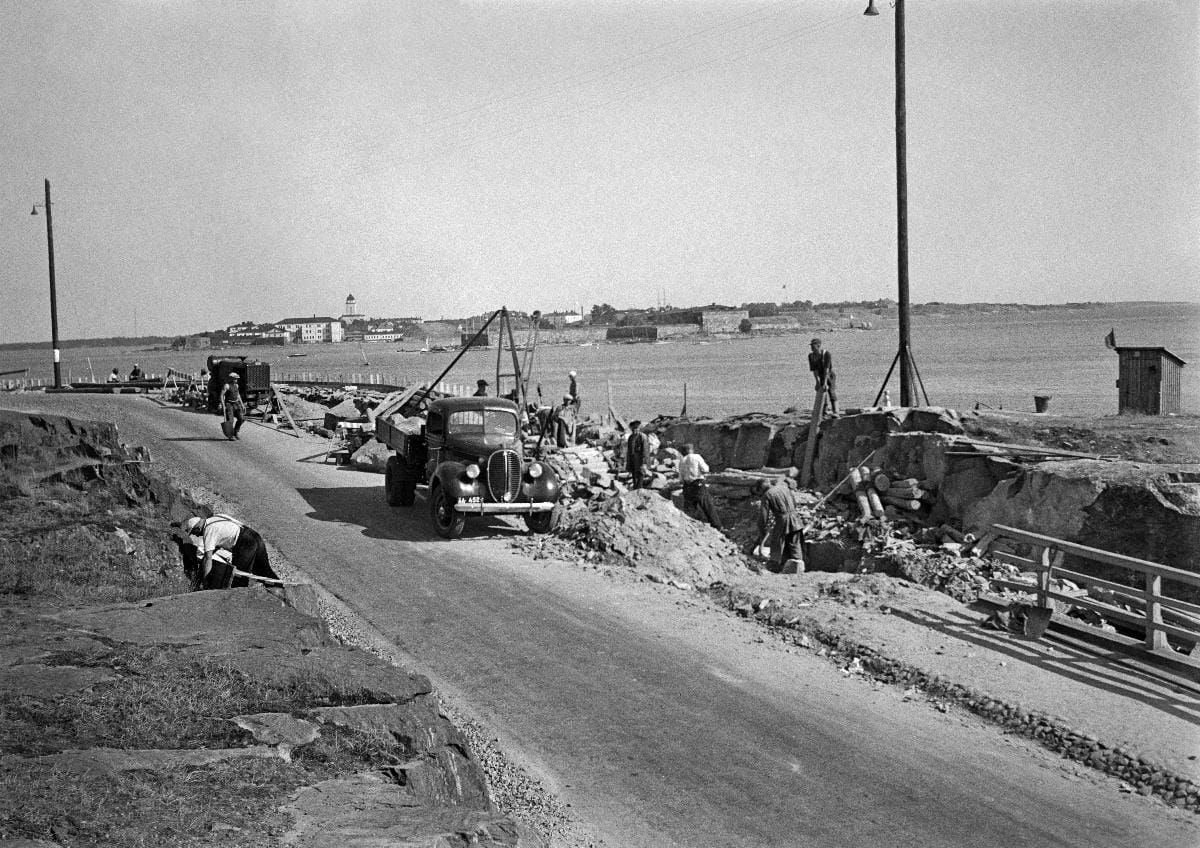
Britain has a long-running joke about roadworks. You're tootling along to get somewhere and then there it is: one person digging a hole and nineteen others standing around watching him.
It has become such a familiar sight that nobody even needs to explain the joke any more. There is the digger. There are the spectators. There is usually a van. Possibly another van. Someone is usually stood drinking coffee and holding a clipboard. Someone else is leaning against something. Someone is keeping an eye on the temporary lights.
And one person is doing the digging.
I've no idea whether this is actually what happens on roadworks. There are presumably very good reasons for most of those people to be there, and I suspect the joke says more about what work looks like from the outside than it does about civil engineering.
But then I think about that interview room again. And meetings.
You know the ones. A room full of people watching two people have the conversation that actually needs to happen, most of whom were invited out of politeness, not because they needed to be there.
Then someone sends everyone in the room, plus another thirty, a note about the conversation. Then there is a meeting about the note. Then someone is asked to coordinate the actions from the meeting. And the notes from the email trail.
Then, three weeks later, somebody asks whether anything has happened yet.
We have become very good at standing around the hole. Sometimes literally. Sometimes with PowerPoint. Sometimes with meetings that eat the morning.
It's a remarkable thing to notice, because there is nothing obviously wrong with any of it. People are busy. People have jobs. People are doing things.
The person with the clipboard may be doing something rather important. The people in the meeting may all have a legitimate reason to be there. The twelve people behind my chair may have been performing a sensible function that I, at twenty-something, simply didn't understand.
And yet there remains something interesting about the picture. One person doing the thing. Everyone else making sure the thing is being done, or spectating.
I wonder how often that happens. Not just in offices, but everywhere.
How many people does it take to make the thing of value, and how many does it take to arrange for the thing to be made?
How many people are actually touching the thing that generates the money? How many are watching? How many are making sure the people touching it are doing it properly? How many are making sure the people making sure are doing their job? At what point does the audience become larger than the cast?
I don't know.
And perhaps that's why the roadworks joke is so persistent. We recognise the shape immediately.
One person is doing something. A surprising number of people are there to support, observe, organise, approve, supervise, record, coordinate, or simply make sure that nobody has forgotten that the one person is doing something.
There is probably a perfectly good reason. There usually is. That's what makes these things so interesting to notice. Nothing ridiculous happens. Nobody says that the operation has become absurd. You simply turn up one morning and discover that there are twelve people behind the chair.
Or nineteen men around a hole. Or eight people in a meeting watching two people try to decide something.
And because everybody is busy, it all looks like work. Which, I suppose, is the bit I keep coming back to. Not whether the people are working. They are. But whether all that work is pointed in the same direction, and how much is orientated around the various forms of value.
I wonder how many places have more people arranging the work than creating whatever it is the rest of us are there for. I wonder how often anyone counts. And I wonder what the room would look like if we did.
Not the spreadsheet. The room. The actual people. Where they're sitting. Who is facing the thing. And who is sitting behind the chair.
I'll ponder that on the drive to Tesco. Oh — I forgot: there's a new bypass under construction. Plenty of roadworks ahead.
"I can't sit still and see another man slaving and working. I want to get up and superintend, and walk round with my hands in my pockets, and tell him what to do. It is my energetic nature. I can't help it."
-- Jerome K. Jerome
Where this sits in the Atlas
Orientation·Idea to Value·Communication·Creativity & Climate·Learning
Hero Image Source from Europeana:
— Street construction work in Helsinki by Sundström, Hugo - Finnish Heritage Agency, Finland - CC BY.