How learning to see is the art of generating ideas (Word at Work)
We use the word idea casually. But it traces back to a Greek verb meaning to see — and that changes how we understand what ideas actually are, and where they come from.
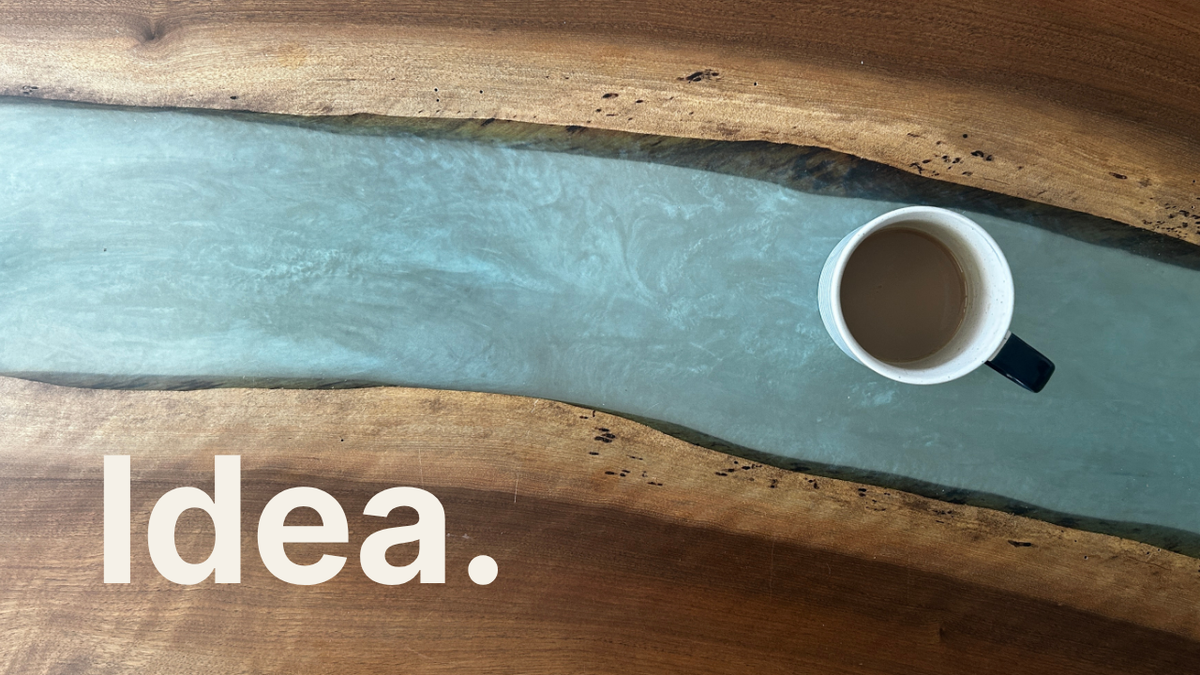
An idea begins with seeing something differently. The interesting part is what happens next.
I have an idea. That's a good idea. Here's an idea worth playing with.
We use the word idea all the time. We have ideas in the shower, on walks, in conversations and occasionally in meetings. We write them in notebooks, scribble them on scraps of paper and send them to ourselves in emails, where some of them go to spend the rest of eternity. I know many of mine do.
But have you ever wondered what an idea actually is?
The history of the word offers a rather lovely place to start. The ancient Greek idéa meant something like form, appearance or pattern, and is related to idein, meaning to see.
To see. Not quite the familiar picture of a light bulb switching on above someone's head. Something more interesting, perhaps. An idea is not always about inventing something from nothing. Sometimes it's about seeing something that was there all along, but that we hadn't quite noticed.
A possibility. A connection. A different way of looking at something familiar. An observation.
And once you've seen it, it's rather difficult to go back to not seeing it.
A notebook, a philosopher and a perfect idea
The ancient Greek philosopher Plato took the word idea and gave it a profound philosophical life.
In his theory of Forms, the things we encounter in the world are imperfect expressions of something more fundamental: an ideal form. The particular things we see and touch are not quite the whole story, they are simply copies of this ideal.
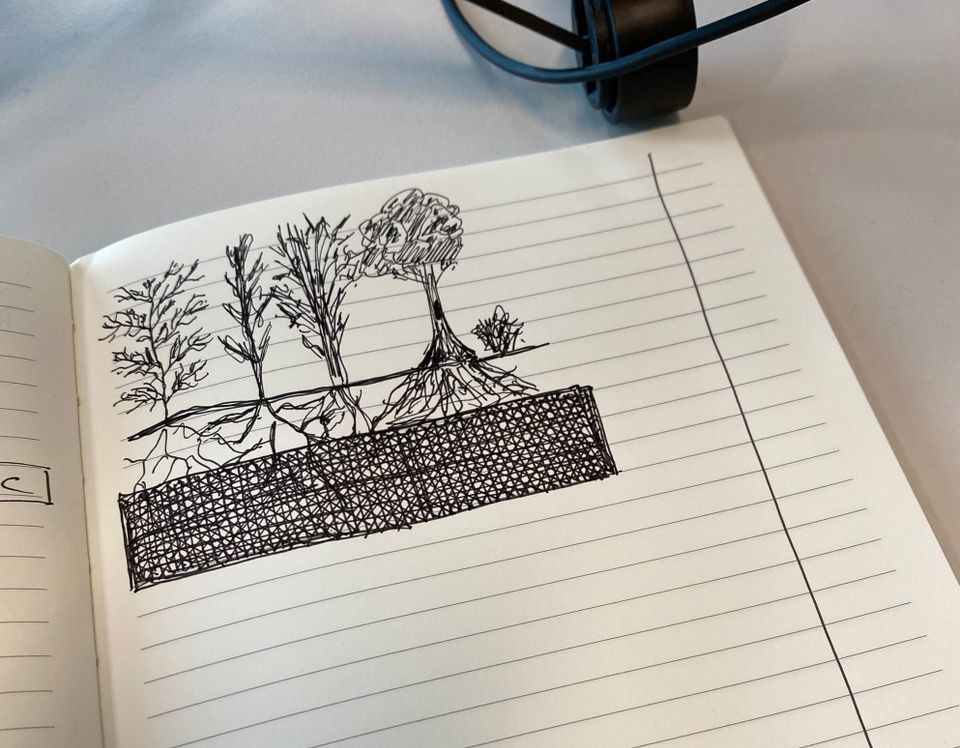
Take this notebook.
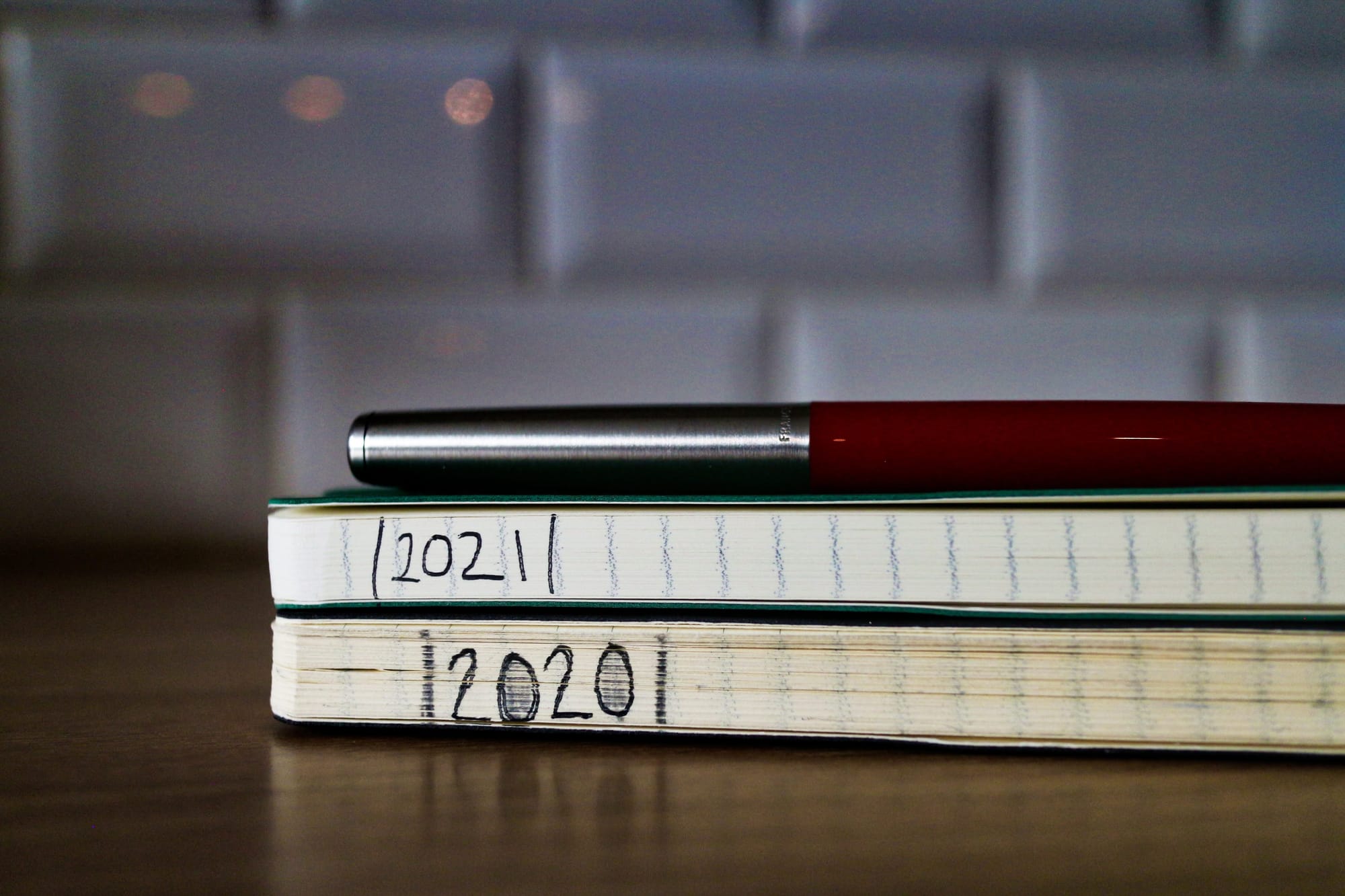
It has a slightly battered cover, a few pages that won't lie flat and a binding that is beginning to show its age. It's perfectly good at being a notebook that I use for journaling, but it's hardly the final word on notebooks.
For Plato, we might say that this particular notebook is an imperfect example of something more enduring: the Form of a notebook, if you like. The ideal against which the individual thing can be understood.
You don't need to agree with Plato to enjoy the thought. It invites us to look beyond the particular object in front of us and consider the pattern, possibility or ideal that it represents.
The word idea has travelled a long way since those philosophical conversations. Its meaning gradually developed towards the mental conceptions we recognise today: thoughts, plans, suggestions and possible courses of action.
Yet that older connection with seeing remains a useful way to think about ideas.
Because sometimes an idea is not a new thing at all. It's a new way of seeing the things we already have.
Seeing is not quite the same as looking
We spend much of our lives looking at things. That doesn't necessarily mean we're seeing them.
You can walk the same route every morning without noticing the sign that's been there for twenty years. You can sit in the same meeting, hear the same discussion and miss the connection that might have changed everything. You can look at a problem from every conceivable angle and still be looking at it in exactly the same way. I often walk through Winchester and spot houses, shops or buildings I hadn't really seen before.
Then something shifts.
A passing remark connects with a book you read last month. A familiar object suggests an unfamiliar use. You notice that two things everyone has treated as separate might actually belong together.
There's the beginning of an idea.
Jacob Bronowski captured this beautifully:
The creative mind is a mind that looks for unexpected likenesses.
Creativity, in this sense, is not simply the ability to produce something unusual. It's the ability to notice relationships, patterns and possibilities that might otherwise escape us. Alan Watt's often described intelligence in a similar way: the ability to see connections.
This is one reason I enjoy collecting quotations, taking photographs, churning through notebooks and going for walks without a particularly urgent destination. These things give me opportunities to notice. They help me make connections between what I've seen, read, heard and experienced.
I might begin with a word and end up with an essay. A photograph might suggest a film. A conversation might send me back to a question I've been thinking about for years. A line from a book might be a breakthrough for a client.
There's no guarantee, of course. Most things we notice lead nowhere in particular. That's part of the fun. Paying attention isn't a vending machine into which we insert observations and receive brilliant ideas on demand.
It's more like cultivating the conditions in which connections have a chance to emerge.
I've written more about this in The Art of Noticing.
Ideas are only the beginning
There is, however, a small complication. An idea can be wonderful and still come to nothing. I always say that an idea holds no value in itself.
Alfred North Whitehead put it rather finely:
Ideas won't keep. Something must be done about them.
I like the urgency in that thought. An idea might feel full of possibility when it first arrives, but possibility and value are not quite the same thing.
A new product, a book, a service, a film, a communication or a business can begin as a glimpse of something that might be worthwhile. But that glimpse is only the beginning. There is still the work of exploring it, testing it, making it, sharing it and finding out whether it delivers what we hoped it would.
Some ideas need to be pursued. Others need to be changed. Some are best left in the notebook.
The trick is not to treat every idea as precious simply because we had it. It's to recognise the possibilities worth pursuing and help them become something real.
This is at the heart of my Idea to Value system. The question isn't simply whether we can generate more ideas. It's whether an idea can become the value it should, or could.
That distinction matters in our personal creative lives, but it matters just as much in organisations.
We can become remarkably good at generating ideas, running workshops, filling whiteboards, optimising portfolios and producing presentations about what might be possible. The activity can feel wonderfully productive. But the real test comes later: what changes because of it?
An idea only begins to deliver its potential when we create the conditions for it to move into the world.
The ideas that make us a little uncomfortable
Oscar Wilde offered a more provocative thought:
An idea that is not dangerous is unworthy of being called an idea at all.
It's a wonderfully Wildean line, and I wouldn't take dangerous too literally. It's not a word we tend to associate with most workplaces. Not every good idea needs to be radical, disruptive or accompanied by a dramatic soundtrack.
But there is something worth considering here.
We often welcome ideas that fit comfortably within what we already believe. They improve an existing process, make a familiar activity a little more efficient or give us a reassuringly tidy answer to a question we already know how to ask. We also tend to be more cautious about anything too radical in the workplace. And if the idea doesn't fit neatly into a spreadsheet, business case or budget line, we have to work extra hard to secure a way to bring it to life.
There's nothing wrong with that. Small improvements can make a genuine difference.
But some of the most valuable ideas ask us to reconsider the question itself. They challenge an assumption, connect things that have been kept apart or suggest that something we have always accepted as inevitable might be otherwise.
These ideas can be uncomfortable because they ask us to see differently before we know exactly what to do next.
Warren Bennis made a related observation about innovation: new ideas are rarely accepted immediately. They require repeated attempts, demonstrations and patience before they become understood and accepted by an organisation.
That takes courage, but it also takes generosity.
If we want good ideas to flourish, we need more than people willing to suggest them. We need people willing to listen, explore, question, experiment and give an unfamiliar possibility enough time to show what it might become.
Sometimes the work is not generating the idea. It's creating the conditions in which it can survive long enough to become useful.
A pile of rocks and a cathedral
There's one quotation I keep coming back to, from Antoine de Saint-Exupéry:
A pile of rocks ceases to be a rock pile when somebody contemplates it with the idea of a cathedral in mind.
I love this because it brings the whole subject together. The rocks haven't changed. Nobody has added anything. But someone has seen a possibility that wasn't apparent to everyone else.
Where one person sees a pile of rocks, another sees a cathedral.
Of course, seeing the cathedral doesn't make it appear. Someone still has to draw the plans, organise the materials, learn the craft and do the work. There will be practical problems, unexpected discoveries and plenty of moments when the finished building seems a very long way away.
But before any of that can happen, someone has to see what might be possible.
That is a remarkable part of being human. We can look at the world as it is and imagine what it might become. We can notice a connection, recognise a need or picture a future that doesn't yet exist.
And then, if the possibility is worth pursuing, we can help bring it into being.
Perhaps we need to pay a little more attention
I sometimes think we make the business of having ideas sound unnecessarily mysterious.
We talk about brainstorming techniques, innovation processes and creative breakthroughs. We search for the perfect conditions in which inspiration will strike, preferably at a convenient time and with a notebook close at hand.
Yet some of our best ideas arrive when we stop trying quite so hard to have them.
On a walk. In a conversation. While reading something unrelated to the problem we're trying to solve. On the train. When we're making a photograph, playing with a piece of paper or looking at a familiar place from a different angle. The notebook helps. So does the camera. So does the walk, the sketch, the question and the moment in which we let our thoughts wander.
Not because any of these things guarantees a good idea, but because they give us ways to pay attention to the world and to our experience of it. We begin to collect things. Words, images, questions, fragments of conversations, observations that might not make sense yet. We give them somewhere to live, and occasionally two of them meet in a way we hadn't expected.
An idea appears.
Perhaps it was waiting for us to notice it. Perhaps we made the connection ourselves. Either way, something has become visible that wasn't visible to us before.
And that feels like a useful way to approach both creativity and work. Look a little more closely. Stay curious. Be willing to see things differently. Give possibilities room to emerge.
Then, when something worthwhile comes into view, do something with it.
Because an idea is often the beginning of the work, not the end.
First, we have to see the possibility. Then we have to help it become real.
The Video
This essay continues on film: the same idea, with more room to show it.
Where this sits in the Atlas
Orientation·Idea to Value·Communication·Creativity & Climate·Learning